Download today's Lesson Outline, or create your FREE account to instantly unlock the complete Premium Study Package✓ Complete verse-by-verse commentary✓ Teacher's and student guides✓ Printable lesson outline✓ Quiz and answer key✓ Additional study resources when available.
From Cleansed Flesh (Tabernacle) to Cleansed Conscience (Christ)
Hebrews 9:11–15
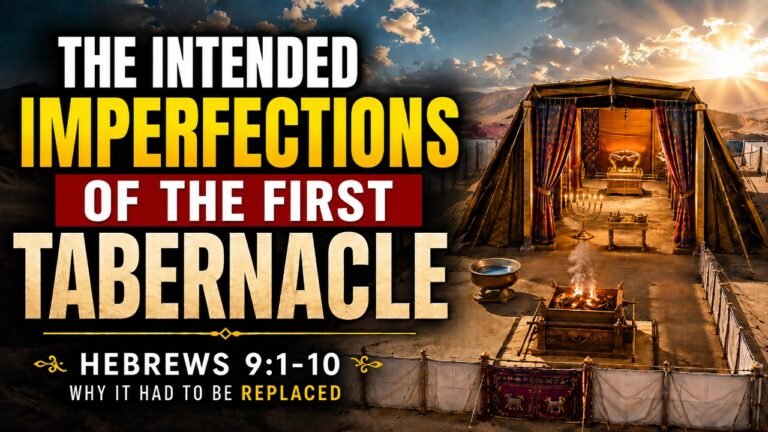
The first ten verses of Hebrews 9 describe a system of worship that God Himself established. The tabernacle, priesthood, sacrifices, washings, and regulations were not defective because something had gone wrong. Their limitations were intentional. They were designed to function only until what Hebrews 9:10 calls “a time of reformation.”
Their fundamental limitation appears in Hebrews 9:9: the sacrifices being offered “cannot make the worshiper perfect in conscience.” They dealt with external matters—“food and drink and various washings, regulations for the body”—but they could not remove the worshiper’s inward consciousness of guilt.
Then Christ came.
The Time of Reformation Arrives — Hebrews 9:11
Hebrews 9:11 does not introduce an unrelated subject. The Greek begins Χριστὸς δὲ παραγενόμενος (Christos de paragenomenos), “and/but when Christ appeared.”
The use of δέ (de) is significant. Rather than marking a sharp break, the writer naturally carries forward the expectation created in verse 10. God had imposed the former regulations until the appointed time of reformation. Verse 11 announces that the anticipated reality has now arrived in Christ.
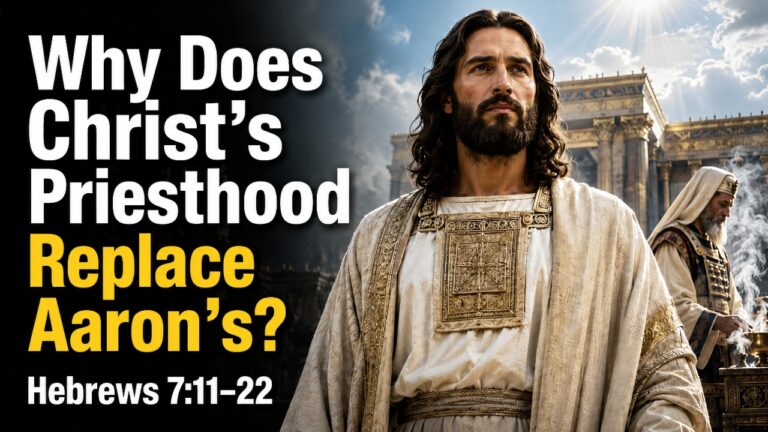
Christ appears as High Priest, but His ministry belongs to an entirely greater order.
The Levitical high priest ministered in an earthly sanctuary. Christ ministers through “the greater and more perfect tabernacle, not made with hands, that is, not of this creation.”
This continues the comparison that dominates the chapter:
an earthly sanctuary versus the heavenly reality;
a Levitical high priest versus Christ;
temporary ceremonies versus eternal realities;
outward cleansing versus inward cleansing.
The earthly tabernacle was constructed according to the pattern God showed Moses. It was therefore real and divinely ordained, but it was nevertheless the lesser earthly representation of the greater heavenly reality.
Christ did not enter the earthly sanctuary to continue the Levitical system. He entered the true sanctuary—the presence of God Himself.
A Greater High Priest With Greater Blood — Hebrews 9:12
The Day of Atonement remains an important background to the writer’s argument.
Under the Levitical system, access to the immediate presence of God was severely restricted. Only the high priest could enter the Most Holy Place, only at the appointed time, and never without blood.
Christ also enters the Holy Place, but everything about His entrance is greater:
“not through the blood of goats and calves, but through His own blood”
The old high priest approached God with the blood of another. Christ approaches through His own blood.
And unlike the recurring ministry of the Levitical priesthood, Christ entered ἐφάπαξ (ephapax)—“once for all.”
That expression exposes one of the great limitations of the former system. Its sacrifices had to be repeated. Repetition itself testified that the problem of sin had not finally been resolved.
Christ does not enter annually.
He enters once for all.
And the result is correspondingly greater:
“having obtained eternal redemption.”
Here the contrast reaches beyond the sanctuary and the sacrifice to the result of the sacrifice. What the former system could never accomplish in finality, Christ actually obtained.
Not temporary redemption.
Not ceremonial restoration for another year.
Eternal redemption.
The former ceremonies anticipated the reality. Christ accomplished it.
The Limitation of Ceremonial Cleansing — Hebrews 9:13
The writer now asks his readers to consider what the former system actually accomplished.
The blood of goats and bulls, together with the ashes of a heifer and the various purification rites God prescribed, did have a legitimate function. Hebrews does not deny their effectiveness within the sphere for which God instituted them.
But their effectiveness had a boundary.
They sanctified “for the cleansing of the flesh.”
That phrase is essential.
The old system operated externally. It dealt with ceremonial defilement and restored a person to the appropriate covenantal and ceremonial standing. But it did not penetrate to the deepest problem of the worshiper.
It could cleanse the flesh.
It could not cleanse the conscience.
This brings the argument directly back to Hebrews 9:9. The inability of those sacrifices to perfect the conscience was not an accidental defect in God’s system. It was part of its intended limitation.
Something greater was still required.
“How Much More” — Hebrews 9:14
The writer now introduces the greater reality:
“how much more will the blood of Christ…”
If the divinely prescribed sacrifices of the former covenant accomplished their intended ceremonial purpose, how much more must the superior sacrifice of Christ accomplish the greater spiritual reality?
Christ, “through the eternal Spirit,” offered Himself without blemish to God.
The verse presents the work of redemption with a distinctly Trinitarian shape: Christ offers Himself, through the eternal Spirit, to God. Yet the writer’s principal concern is the efficacy of Christ’s sacrifice.
And here we finally reach what the former system could never accomplish:
“cleanse your conscience from dead works to serve the living God.”
This is the great movement of Hebrews 9:1–14:
The former system cleansed the flesh. Christ cleanses the conscience.
The problem was never merely ceremonial impurity. Man requires true forgiveness of sin—an actual removal of guilt before God.
The blood of Christ provides precisely that.
The worshiper no longer approaches God with a conscience continually reminded that sin remains unresolved. Christ’s sacrifice deals with sin in such a manner that the conscience itself can be cleansed from guilt.
And the purpose is not merely psychological relief:
“to serve the living God.”
A cleansed conscience makes genuine service and genuine access to God possible.
From Restricted Access to the Presence of God
The structure of the tabernacle itself preached restriction.
The closer one came to the immediate presence of God, the greater the restriction became. Ultimately, only the high priest could enter the Most Holy Place.
And even after the annual Day of Atonement had been completed, the restriction remained. The entire nation did not suddenly enter the Most Holy Place. The high priest alone still possessed that ceremonial access.
Christ changes that reality.
His once-for-all entrance into the heavenly sanctuary was not merely an entrance for Himself. By obtaining eternal redemption, He secured access to God for His people.
This is why Hebrews can elsewhere exhort believers to draw near and to come boldly to the throne of grace.
The Levitical system demonstrated that sinful humanity cannot simply enter the presence of a holy God.
Christ provides the answer.
He deals with the sin.
He cleanses the conscience.
He obtains eternal redemption.
And through His priestly ministry, those who belong to Him are brought into the presence of God.
The Mediator of a New Covenant — Hebrews 9:15a
The writer therefore concludes:
“And for this reason He is the mediator of a new covenant…”
For this reason.
Because Christ has accomplished what the former system was never intended finally to accomplish, He is the mediator of the new covenant.
The first covenant could regulate ceremonial worship and provide outward cleansing. It could point forward to forgiveness. It could teach the holiness of God, the seriousness of sin, the necessity of blood, and the difficulty of entering God’s presence.
But it could not perfect the conscience.
Christ brings the intended fulfillment.
The blood of the old covenant cleansed the flesh.
The blood of Christ cleanses the conscience.
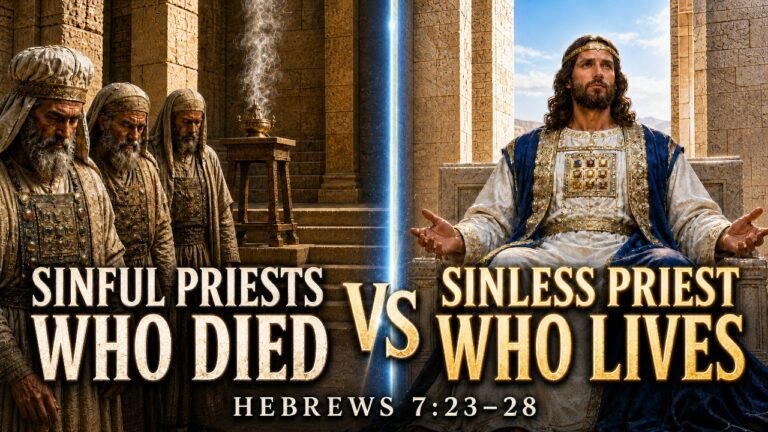
The former high priest entered repeatedly.
Christ entered once for all.
The former sanctuary was earthly.
Christ entered the heavenly sanctuary.
The former sacrifices provided temporary ceremonial benefits.
Christ obtained eternal redemption.
And because His sacrifice truly deals with sin, those who trust in Him are no longer kept at a distance. Through Christ, the way into the presence of God has been opened.
Deep biblical study with insights from the original Greek and Hebrew texts.
Exploring the richness of Scripture through detailed study of the original biblical languages, grammar, historical background, and literary context to uncover the depth and precision of God’s revelation.
Verse-by-verse teaching rooted in the authority of Scripture.
Carefully walking through each passage in its biblical context, examining the meaning of the text line by line, with a commitment to faithful interpretation and the full authority of God’s Word.
Clear, serious exposition focused on truth, context, and sound doctrine.
Presenting Scripture with clarity and careful analysis, emphasizing accurate interpretation, theological depth, and the importance of understanding God’s Word within its proper historical and biblical context.
Christ-centered teaching that equips believers to understand and live God’s Word.
Focusing on the person and work of Jesus Christ while helping believers grow in spiritual maturity, biblical understanding, discernment, and faithful obedience to the truths of Scripture.
Exploring Scripture carefully, faithfully, and without compromise.
Approaching the Bible with reverence, precision, and integrity—seeking to handle the text honestly, remain faithful to its intended meaning, and uphold the truth of God’s Word without distortion or cultural pressure.
Stay Connected to New Studies
Stay connected with the latest Bible studies, verse-by-verse teachings, article updates, and new video content. Join the newsletter to receive thoughtful biblical teaching, Scripture insights, and ministry updates directly in your inbox.
Have more questions?
If you would like more information about the ministry, need assistance with the website or resources, or simply want to get in touch, feel free to send a message .

Why Was a New Covenant Needed?