Download today's Lesson Outline, or create your FREE account to instantly unlock the complete Premium Study Package✓ Complete verse-by-verse commentary✓ Teacher's and student guides✓ Printable lesson outline✓ Quiz and answer key✓ Additional study resources when available.
The transition of the passion narrative from Mark 14 to Mark 15 represents one of the most legally complex and theologically profound shifts in Holy Scripture. Following a late-night, highly irregular interrogation by the Sanhedrin council, the religious elite of Jerusalem achieved their desired internal verdict: a declaration that Jesus of Nazareth was guilty of capital blasphemy for affirming his divine status as the Danielic Son of Man.
However, a major political hurdle stood between their verdict and their ultimate goal. Under Roman provincial occupation, the Jewish Sanhedrin possessed no sovereign authority to carry out capital punishment. To see Jesus executed, they had to transfer his case from the ecclesiastical courts to the Roman civil court, presided over by the Roman Procurator of Judea, Pontius Pilate.
From Theology to Treason
To ensure Roman intervention, the chief priests, elders, and scribes could not simply present a charge of blasphemy. Pilate, a pragmatic and historically ruthless Roman administrator, would have immediately dismissed an internal theological dispute. The leadership had to re-engineer the accusation entirely.
When they bound Jesus and delivered him to the Praetorium early in the morning, they presented him not as a religious heretic, but as a political insurgent—a direct threat to the sovereignty of Caesar. This explains Pilate’s immediate, sharp opening question in Mark 15:2: “Are you the King of the Jews?” Under Roman law, claiming kingship independent of imperial authorization constituted high treason (maiestas), a crime punishable by the most severe forms of public execution.
The Majesty of Sovereign Silence
Christ’s response to the governor is brief and highly nuanced: “It is as you say.” This qualified affirmation acknowledges his true, transcendent status as Israel’s King while deliberately rejecting the violent, militaristic, and revolutionary connotations that Pilate associated with the title.
What followed completely unsettled the experienced Roman magistrate. As the chief priests hurled a voluminous stream of secondary accusations against him, Jesus maintained absolute silence. In the Greco-Roman judicial tradition, a defendant’s silence in a capital trial was considered bizarre, often interpreted as an admission of guilt or a sign of contempt. Yet, Christ’s quiet reserve was a powerful display of majestic control, perfectly fulfilling the prophetic portrait of the Suffering Servant outlined in Isaiah 53:7: “like a lamb that is led to the slaughter… so He opened not His mouth.”
The Ultimate Substitutionary Exchange
Discerning that the religious leaders were driven entirely by institutional envy rather than genuine loyalty to the Roman Emperor, Pilate attempted to utilize a customary Passover amnesty tradition to release Jesus. He placed a stark choice before the gathered crowd: release Jesus, whom he pointedly referred to as the King of the Jews, or release Barabbas.
The historical profile of Barabbas is critical to understanding the depth of this text. Barabbas was not a mere petty criminal; Mark notes that he was an insurrectionist who had committed murder during a recent armed rebellion against the Roman occupation. The chief priests aggressively moved through the crowd, acting as instigators to manipulate the volatile multitude. They successfully convinced the crowd to reject their true Messiah and demand the release of a violent terrorist instead.
When Pilate, seeking a legal basis for execution, asked the crowd, “Why, what evil has he done?”—a question that stands as an official historical declaration of Christ’s absolute innocence—the mob simply amplified their unreasoning rage, crying out, “Crucify him!”
The Price of Political Compromise
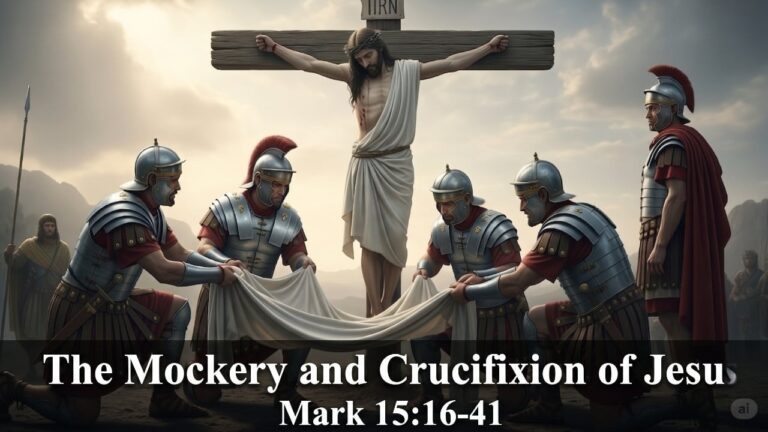
Ultimately, Pilate chose personal political expediency over absolute justice. Fearful that an uncontrolled riot during a major religious festival would reach the ears of Emperor Tiberius and signal administrative incompetence, he capitulated to the mob. He released Barabbas, ordered the innocent Son of God to be brutally scourged with the Roman flagrum, and signed the official death warrant delivering Christ to be crucified.
In this dark moment of political corruption, the Gospel reveals a stunning, graphic picture of substitutionary atonement. Barabbas, the guilty rebel, walked out of his prison cell into absolute freedom because the innocent King of Kings voluntarily took his place upon the Roman cross.
Deep biblical study with insights from the original Greek and Hebrew texts.
Exploring the richness of Scripture through detailed study of the original biblical languages, grammar, historical background, and literary context to uncover the depth and precision of God’s revelation.
Verse-by-verse teaching rooted in the authority of Scripture.
Carefully walking through each passage in its biblical context, examining the meaning of the text line by line, with a commitment to faithful interpretation and the full authority of God’s Word.
Clear, serious exposition focused on truth, context, and sound doctrine.
Presenting Scripture with clarity and careful analysis, emphasizing accurate interpretation, theological depth, and the importance of understanding God’s Word within its proper historical and biblical context.
Christ-centered teaching that equips believers to understand and live God’s Word.
Focusing on the person and work of Jesus Christ while helping believers grow in spiritual maturity, biblical understanding, discernment, and faithful obedience to the truths of Scripture.
Exploring Scripture carefully, faithfully, and without compromise.
Approaching the Bible with reverence, precision, and integrity—seeking to handle the text honestly, remain faithful to its intended meaning, and uphold the truth of God’s Word without distortion or cultural pressure.
Stay Connected to New Studies
Stay connected with the latest Bible studies, verse-by-verse teachings, article updates, and new video content. Join the newsletter to receive thoughtful biblical teaching, Scripture insights, and ministry updates directly in your inbox.
Have more questions?
If you would like more information about the ministry, need assistance with the website or resources, or simply want to get in touch, feel free to send a message.

The Burial and Resurrection of Jesus (Mark 14:42-16:8)