Download today's Lesson Outline, or create your FREE account to instantly unlock the complete Premium Study Package✓ Complete verse-by-verse commentary✓ Teacher's and student guides✓ Printable lesson outline✓ Quiz and answer key✓ Additional study resources when available.
Hebrews 9 continues the argument begun in the previous chapter. Hebrews 8 explained why a new covenant was necessary. Hebrews 9 now turns to the sanctuary and worship associated with that first covenant.
The writer’s purpose is not to criticize the Mosaic system as though it were defective in origin. God Himself established it. Rather, its limitations were intentional. The first tabernacle was designed to function temporarily and to point forward to the greater and effectual work of Christ.
Hebrews 9:1 — The Earthly Sanctuary
“Now even the first covenant had regulations of divine worship and the earthly sanctuary.”
The first covenant had its own divinely prescribed system of worship. Its priesthood, ceremonies, sacrifices, and sanctuary all came from God.
Yet the writer deliberately calls it an earthly sanctuary. That language anticipates the contrast that will later be made with the greater tabernacle associated with Christ.
The Mosaic sanctuary was divine in origin, but temporal in function.
Hebrews 9:2–5 — The Contents of the Tabernacle
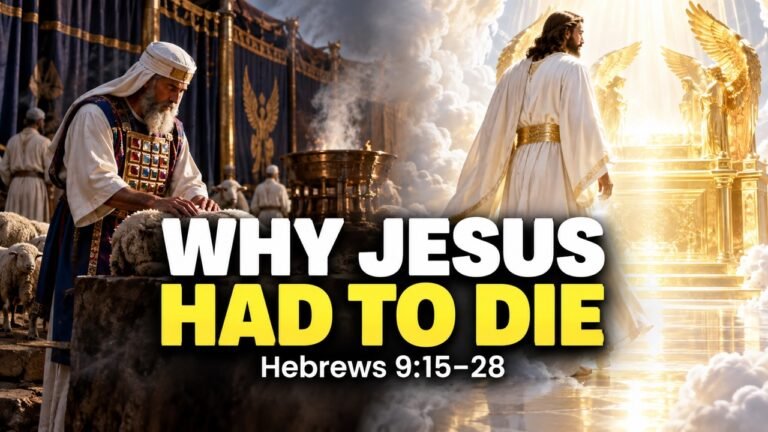
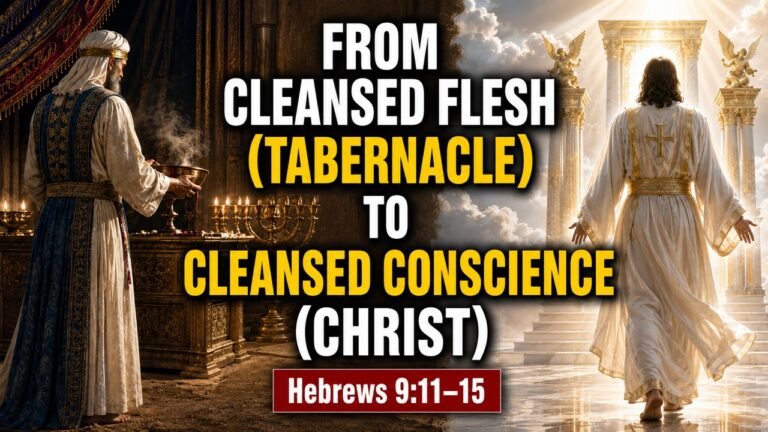
The writer begins by describing the tabernacle itself. Significantly, he does not discuss the outer court. His attention is restricted to the sanctuary proper—the Holy Place and the Most Holy Place.
This fits the dominant concern of the passage: access into the presence of God.
In the Holy Place were the lampstand, the table, and the sacred bread. Because the sanctuary was covered, there was no natural light inside. The lampstand provided the light by which the priests ministered. It fittingly portrays dependence upon the light God Himself provides rather than the light of the world.
The bread of the Presence likewise testified to divine provision. Israel’s life depended ultimately upon God, not upon natural resources alone.
Behind the veil was the Most Holy Place, representing the immediate manifested presence of God. The very arrangement of the sanctuary demonstrated increasing restriction. Each entrance brought the worshiper nearer to God, while at the same time emphasizing that access was carefully controlled.
The writer also mentions the golden altar of incense, associated functionally with the Most Holy Place. Its incense continually rose before the veil and represented the prayers of God’s people ascending before Him.
Within the ark were the golden jar containing manna, Aaron’s rod that budded, and the tablets of the covenant. The manna testified to God’s providential provision. Aaron’s rod testified to God’s sovereign appointment of the priesthood. The tablets testified to the covenant word by which Israel stood in relationship with God.
Above the ark were the cherubim overshadowing the mercy seat—the place of propitiation where blood was presented before God.
The writer then stops himself:
“But of these things we cannot now speak in detail.”
His purpose is not to provide an exhaustive explanation of every article. He has described the sanctuary sufficiently to move to his primary concern: the ministry performed within it.
Hebrews 9:6–7 — Continual and Restricted Ministry
The priests entered the first part of the tabernacle continually.
That word is important.
The lamps required regular attention. Incense was offered morning and evening. The bread of the Presence was replaced every Sabbath. The entire priestly ministry was repetitive.
But entrance into the Most Holy Place was dramatically different.
Only the high priest could enter.
He entered only once each year.
And he could never enter without blood.
The system therefore proclaimed restriction. Access to the immediate presence of God was limited by person, office, time, place, and sacrifice.
The writer adds that the blood was offered for the sins of the people committed in ignorance. This recalls the distinction in Numbers 15 between unintentional sins and deliberate, high-handed rebellion.
That distinction exposes one of the great limitations of the old system. Human beings do not sin merely through ignorance. Much of our sin is committed knowingly and deliberately. The Law itself gives the knowledge of sin, yet men still rebel against what God has commanded.
The old system therefore could never provide the final answer to the entirety of human guilt.
Hebrews 9:8–9 — The Meaning of the Arrangement
The writer now tells us what the Holy Spirit was communicating through this system.
The restricted sanctuary itself was a message.
As long as the first tabernacle remained, the way into the immediate presence of God had not yet been fully manifested.
The tabernacle was therefore a parable for that present age. Its sacrifices, ceremonies, and priestly services were real and divinely commanded, but they pointed beyond themselves.
Their great limitation was this:
they “cannot make the worshiper perfect in conscience.”
The ceremonies could regulate outward worship, but they could not finally remove the consciousness of sin.
The worshiper could participate in the prescribed sacrifices and still leave knowing that the problem of sin had not been permanently resolved.
Hebrews 9:10 — Until the Time of Reformation
The writer summarizes the Mosaic system as consisting of foods, drinks, washings, and various regulations for the flesh.
These were external ordinances. They dealt with ceremonial purity and bodily participation in covenant worship.
But man’s fundamental problem is deeper than the flesh.
His conscience is defiled.
His guilt remains.
His sin separates him from the presence of a holy God.
Therefore these regulations were imposed only:
“until a time of reformation.”
That statement reveals the temporary nature of the entire system.
The first tabernacle was not a divine mistake. Its imperfections were intentional. God designed it to teach that something greater was still required.
Its repeated sacrifices taught that the work was unfinished.
Its restricted access taught that the way into God’s presence was not yet fully opened.
Its external regulations taught that man required an inward cleansing.
And its inability to perfect the conscience pointed forward to a sacrifice capable of dealing with sin completely.
That is why the next section begins with the decisive words:
“But when Christ appeared…”
The first tabernacle was always intended to give way to the greater reality found in Christ.
Deep biblical study with insights from the original Greek and Hebrew texts.
Exploring the richness of Scripture through detailed study of the original biblical languages, grammar, historical background, and literary context to uncover the depth and precision of God’s revelation.
Verse-by-verse teaching rooted in the authority of Scripture.
Carefully walking through each passage in its biblical context, examining the meaning of the text line by line, with a commitment to faithful interpretation and the full authority of God’s Word.
Clear, serious exposition focused on truth, context, and sound doctrine.
Presenting Scripture with clarity and careful analysis, emphasizing accurate interpretation, theological depth, and the importance of understanding God’s Word within its proper historical and biblical context.
Christ-centered teaching that equips believers to understand and live God’s Word.
Focusing on the person and work of Jesus Christ while helping believers grow in spiritual maturity, biblical understanding, discernment, and faithful obedience to the truths of Scripture.
Exploring Scripture carefully, faithfully, and without compromise.
Approaching the Bible with reverence, precision, and integrity—seeking to handle the text honestly, remain faithful to its intended meaning, and uphold the truth of God’s Word without distortion or cultural pressure.
Stay Connected to New Studies
Stay connected with the latest Bible studies, verse-by-verse teachings, article updates, and new video content. Join the newsletter to receive thoughtful biblical teaching, Scripture insights, and ministry updates directly in your inbox.
Have more questions?
If you would like more information about the ministry, need assistance with the website or resources, or simply want to get in touch, feel free to send a message.
Why Was a New Covenant Needed?