Download today's Lesson Outline, or create your FREE account to instantly unlock the complete Premium Study Package✓ Complete verse-by-verse commentary✓ Teacher's and student guides✓ Printable lesson outline✓ Quiz and answer key✓ Additional study resources when available.
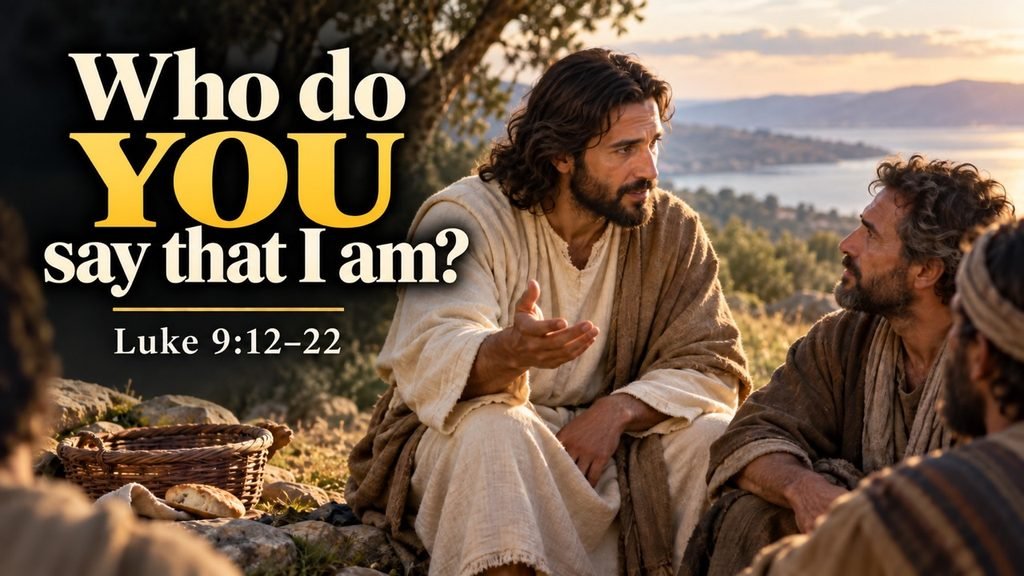
It is possible to witness the works of Jesus and still fail to recognize who he is. It is also possible to confess his identity correctly while struggling to understand the mission he came to accomplish. Luke 9:12–22 brings both realities before us, moving from the feeding of the multitude to Peter’s confession and Jesus’ announcement of his necessary suffering, death, and resurrection.
The question Jesus puts to his disciples also confronts us personally: Who do YOU say that he is?
A need beyond the disciples’ resources
The Twelve have returned from their mission. Jesus withdraws with them toward Bethsaida, but the people follow. He welcomes the crowd, speaks about the kingdom of God, and heals those who need healing.
As evening approaches, the disciples suggest a practical solution to the need for food and lodging: send the people into the surrounding settlements. Jesus instead directs the disciples to feed them. Their supply is five loaves and two fish, while the men alone number about five thousand. Matthew’s parallel account also mentions women and children, without specifying the total population.
What is Jesus teaching through this command? This study understands it as drawing the disciples’ attention to his person and power. We should not turn this particular instruction into a standing command that apostles and future church leaders must supply everyone’s material needs. The voluntary sharing described in Acts 4:32–35 is a separate subject. Here, Jesus brings the Twelve to a task beyond their resources so that they encounter his ability to provide.
He directs them to arrange the people in groups of about fifty. After looking toward heaven and blessing the food, he breaks it and gives it to the disciples to distribute. They serve what he supplies. Everyone eats and is satisfied, and twelve baskets of broken pieces remain.
There is a particular lesson for the Twelve in this miracle. Jesus’ recorded instructions are addressed to them, and the provision passes through their hands. In that sense, we may call it a private demonstration to the disciples, without suggesting that the crowd did not benefit or could not recognize what had happened.
Elisha, Yahweh’s word, and the greater provision of Jesus
Second Kings 4:42–44 provides a striking comparison. Elisha receives twenty barley loaves and directs that they be given to a hundred men. His attendant objects to the apparent insufficiency. Elisha answers by declaring Yahweh’s promise: the people will eat and have food remaining. The outcome fulfills the word of the Lord.
The distinction matters. Elisha explicitly places the source and authority of the provision in Yahweh. He is God’s prophetic instrument; the power is not his own.
In Luke, Jesus personally supplies the multitude, feeding vastly more people from an even smaller initial supply. His looking toward heaven and blessing the food expresses his communion with the Father. Read alongside John’s presentation of the Word who was God and became flesh, this is the divine Son revealing his ability to provide. The same feeding appears in John’s Gospel, whose selected signs bear witness that Jesus is the Christ, the Son of God, so that believing people may have life in him (John 1:1–18; 20:30–31).
The twelve baskets also invite reflection. There are twelve apostles and twelve tribes of Israel. The bread of the Presence consisted of twelve loaves arranged before the Lord in connection with his covenant with Israel (Leviticus 24:5–9). A theological echo is possible here: God provides for his people. Luke does not explicitly interpret the baskets through the showbread, but the association is worth considering. The unmistakable fact is the abundance of Jesus’ provision.
From the crowd’s opinions to the disciples’ confession
In the next scene, Jesus is praying with the disciples present. He asks who the crowds say he is. They report familiar opinions: John the Baptist, Elijah, or an ancient prophet risen again. These repeat the reports earlier in Luke 9:7–8.
The people recognize something extraordinary, yet they attempt to account for Jesus within familiar prophetic categories. They have witnessed his works without fully recognizing his person.
Jesus then turns the question toward those who have been with him: What do they themselves say? Peter identifies him as the Christ of God.
Matthew 16:16–17 records the fuller confession of Jesus as the Christ, the Son of the living God, and attributes Peter’s recognition to the Father’s revelation. The Christ is the promised Messiah; the wider Gospel witness reveals that this Messiah is the divine Son.
Luke’s shorter wording raises an interesting question. Is he condensing the fuller confession? Does this expression also fit his attention to the Messiah’s genuine humanity? These remain possibilities, rather than conclusions on which to be dogmatic. The expression identifies Jesus as God’s Messiah, but its grammar alone does not establish that “of God” substitutes for “Son of God.”
Why the stern command to remain silent?
After this confession, Jesus sternly warns the disciples not to tell anyone. Why should a true confession be followed by such a forceful restriction?
I understand the warning as addressing the disciples’ own preparation to bear witness. Jesus has already revealed his mission publicly in word and deed. At Nazareth, he applied Isaiah’s description of the anointed messenger to himself and declared its fulfillment (Luke 4:16–21). The issue is not that his identity has never been disclosed.
The disciples, however, still need to digest what they have confessed. They can identify the Messiah while resisting the necessity of his suffering. Matthew makes this especially clear: shortly after Peter’s confession, Peter objects to Jesus’ announcement of his coming death (Matthew 16:21–23). Luke later records their continuing failure to understand his prediction (Luke 18:31–34).
Their preparation unfolds through the resurrection and the risen Lord’s instruction. Jesus opens their understanding of the Scriptures and directs them to await the Father’s promise (Luke 24:45–49). Acts 1:8 connects the coming of the Holy Spirit with power for their witness. At Pentecost, Peter publicly proclaims the crucified and risen Jesus as Lord and Christ.
This supplies a coherent explanation for the earlier restriction: the witnesses themselves need preparation for the message they will proclaim. Luke 9:21 does not expressly state the reason, so this remains an interpretation supported by the larger narrative. It also reminds teachers of the seriousness of understanding what they proclaim, a responsibility James 3:1 underscores.
The Messiah must suffer—and rise
Jesus immediately explains the necessary course of his mission. The Son of Man must suffer, be rejected by the elders, chief priests, and scribes, be killed, and be raised on the third day.
The Greek word dei, “must,” governs this entire sequence. These events belong to God’s saving purpose. The suffering and death the disciples find so difficult to accept are essential to the salvation Christ brings, personally and in God’s purposes for Israel. His resurrection belongs to that same necessity.
All of redemptive history converges on the cross. What precedes anticipates it; what follows looks back to it. We cannot understand the Messiah’s saving mission while rejecting the cross and resurrection through which he accomplishes it.
Jesus’ question therefore reaches beyond the disciples. Knowing the opinions of the crowd is not enough. Each of us must reckon with his person and his work.
Deep biblical study with insights from the original Greek and Hebrew texts.
Exploring the richness of Scripture through detailed study of the original biblical languages, grammar, historical background, and literary context to uncover the depth and precision of God’s revelation.
Verse-by-verse teaching rooted in the authority of Scripture.
Carefully walking through each passage in its biblical context, examining the meaning of the text line by line, with a commitment to faithful interpretation and the full authority of God’s Word.
Clear, serious exposition focused on truth, context, and sound doctrine.
Presenting Scripture with clarity and careful analysis, emphasizing accurate interpretation, theological depth, and the importance of understanding God’s Word within its proper historical and biblical context.
Christ-centered teaching that equips believers to understand and live God’s Word.
Focusing on the person and work of Jesus Christ while helping believers grow in spiritual maturity, biblical understanding, discernment, and faithful obedience to the truths of Scripture.
Exploring Scripture carefully, faithfully, and without compromise.
Approaching the Bible with reverence, precision, and integrity—seeking to handle the text honestly, remain faithful to its intended meaning, and uphold the truth of God’s Word without distortion or cultural pressure.
Stay Connected to New Studies
Stay connected with the latest Bible studies, verse-by-verse teachings, article updates, and new video content. Join the newsletter to receive thoughtful biblical teaching, Scripture insights, and ministry updates directly in your inbox.
Have more questions?
If you would like more information about the ministry, need assistance with the website or resources, or simply want to get in touch, feel free to send a message.