Download today's Lesson Outline, or create your FREE account to instantly unlock the complete Premium Study Package✓ Complete verse-by-verse commentary✓ Teacher's and student guides✓ Printable lesson outline✓ Quiz and answer key✓ Additional study resources when available.
Luke 8:19–39 may initially appear to contain several disconnected episodes: Jesus’ mother and brothers seek Him, Jesus calms a violent storm, and then He delivers a demon-possessed man in the country of the Gerasenes. Yet Luke has woven these events together around one central question:
Who is Jesus?
The answer makes Jesus’ words concerning His spiritual family all the more remarkable.
“My Mother and My Brothers”
Jesus’ mother and His half-brothers came looking for Him while He was surrounded by the crowd. This occurred in the same general setting as His teaching of the parables. Mark’s parallel account helps establish the chronology, noting that the crossing of the Sea of Galilee occurred “on that day” (Mark 4:35).
When Jesus was informed that His family was waiting for Him, He responded by identifying a greater spiritual relationship:
His true family consists of those who hear the word of God and do it.
Jesus was not dishonoring Mary or His brothers. Rather, He was establishing the priority of a new spiritual family—those united to Him through faith and demonstrated obedience to the Word of God.
This same emphasis later appears prominently in the writing of James, Jesus’ own half-brother: hearing the Word is not enough; it must be practiced.
There is also a remarkable connection with Psalm 22:22, where the Messiah speaks of declaring God’s name to His brothers. Hebrews 2:11–12 applies that passage directly to Christ, emphasizing that He is not ashamed to call His people brothers.
That should never become ordinary to us.
Human beings are sinners. All have sinned (Romans 3:23), and the wages earned by sin is death (Romans 6:23). We possess no inherent claim upon God’s favor. Yet the eternal, holy Son of God has condescended not only to become flesh and die for His people, but to identify those whom He has redeemed as His brothers.
The remainder of Luke 8:19–39 shows us just how extraordinary that designation really is.
“Who Then Is This?”
Jesus entered a boat with His disciples and instructed them to cross the Sea of Galilee. Exhausted from the ministry of the day, He fell asleep—a clear testimony to His genuine humanity.
Then a violent storm descended upon the lake.
Several of the disciples were experienced fishermen. Peter, James, and John were not strangers to the dangers of the Sea of Galilee. Yet this storm was severe enough to terrify even them. The boat was filling with water, and they believed they were about to die.
They woke Jesus in desperation.
Jesus arose and rebuked the wind and the raging water, and immediately there was calm.
The language is significant. Jesus does not merely pray for the storm to cease. He commands it.
There are reasons to consider the possibility that this storm carried demonic influence. Satan repeatedly sought to prevent Christ from reaching the cross. Later, when Peter attempted to discourage Jesus from going to Jerusalem to suffer and die, Jesus recognized the satanic influence behind Peter’s words and answered, “Get behind Me, Satan.”
Here, likewise, the unusually violent nature of the storm and Jesus’ language of rebuke may indicate more than an ordinary weather event. This should not be pressed dogmatically, but the possibility fits the larger biblical conflict surrounding Christ’s mission.
After calming the storm, Jesus turned to His disciples and asked:
“Where is your faith?”
Their fear now changed.
They were no longer merely afraid of the storm.
They were afraid of Jesus.
They looked at one another in amazement and asked:
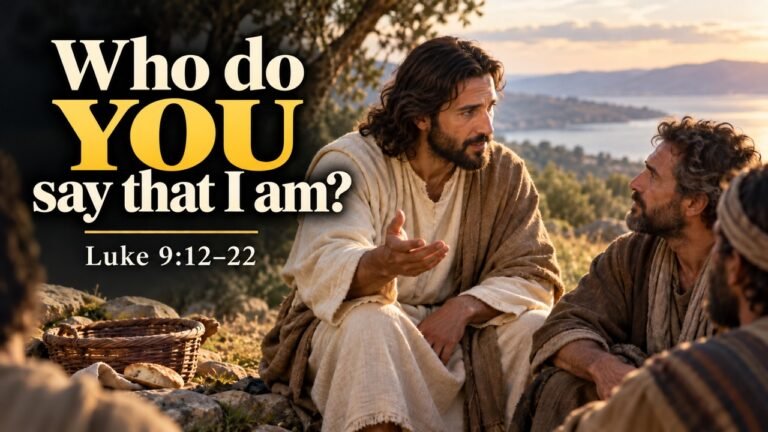
“Who then is this, that He commands even the winds and the water, and they obey Him?”
That question becomes the theological center of the entire passage.
The Demons Know Who He Is
When Jesus reached the country of the Gerasenes, He encountered a man possessed by many demons. The man had lived among the tombs, wore no clothing, and possessed unnatural strength. Attempts to restrain him with chains had failed.
Yet when he encountered Jesus, everything changed.
The demon-possessed man fell before Him.
The demons immediately recognized what the disciples were still struggling to understand:
“Jesus, Son of the Most High God.”
They knew who stood before them.
The disciples had asked, “Who then is this?”
The demons answered:
He is the Son of the Most High God.
Jesus then demonstrated absolute authority over the demonic realm. The demons could not act independently. They begged Him concerning what He would permit them to do.
They specifically pleaded with Him not to command them into the abyss.
The abyss is presented in Scripture as a place of confinement associated with demonic beings. Revelation 9 describes the opening of the abyss and the release of terrifying demonic forces during future judgment. Thus, the demons’ plea in Luke reveals that they understood Jesus possessed authority not merely over their present activity but over their confinement and ultimate destiny.
They could go nowhere unless He permitted it.
Jesus allowed them to enter a nearby herd of swine. The animals immediately rushed down the steep bank into the lake and drowned—another vivid demonstration of the destructive nature of demonic possession.
“What Great Things God Has Done for You”
When the people of the region arrived, they found the formerly demon-possessed man sitting at Jesus’ feet, clothed and in his right mind.
Instead of rejoicing over what had happened, however, the people were overcome with fear and asked Jesus to leave their region.
Jesus complied.
But the delivered man wanted to go with Him.
Jesus gave him another assignment:
Return home and tell what great things God has done for you.
Then Luke gives us the decisive statement:
The man went throughout the city proclaiming what great things Jesus had done for him.
That is not accidental wording.
Jesus said:
Tell what God has done for you.
Luke says the man proclaimed:
What Jesus had done for him.
God and Jesus are deliberately brought together.
The question from verse 25 has now been answered.
Who Is This?
The disciples asked:
“Who then is this?”
The answer unfolds throughout the passage.
He commands the wind.
He commands the water.
He commands demons.
He determines whether demons remain free or are confined to the abyss.
The demons identify Him as the Son of the Most High God.
And Luke identifies the works of Jesus with the works of God.
Who is Jesus?
He is God the Son.
And this is what makes the opening words of the passage so astonishing.
The One who commands creation calls His redeemed people brothers.
The One before whom demons tremble calls His people brothers.
The eternal Son, holy in the absolute sense, the Creator and sovereign Lord of all things, has graciously brought sinful human beings into His family.
We are not worthy of that designation by merit. We deserve judgment because of sin. Salvation is entirely an act of divine grace.
That grace should produce more than intellectual appreciation.
It should produce obedience.
Jesus began the section by identifying His family as those who hear the Word of God and do it.
That is the fitting response of those who understand who He is and what He has graciously made them.
Central Truth
Jesus, our Brother, is God.
And because the eternal Son has graciously called us His own, the proper response of the redeemed is grateful, loving obedience to His Word.
Deep biblical study with insights from the original Greek and Hebrew texts.
Exploring the richness of Scripture through detailed study of the original biblical languages, grammar, historical background, and literary context to uncover the depth and precision of God’s revelation.
Verse-by-verse teaching rooted in the authority of Scripture.
Carefully walking through each passage in its biblical context, examining the meaning of the text line by line, with a commitment to faithful interpretation and the full authority of God’s Word.
Clear, serious exposition focused on truth, context, and sound doctrine.
Presenting Scripture with clarity and careful analysis, emphasizing accurate interpretation, theological depth, and the importance of understanding God’s Word within its proper historical and biblical context.
Christ-centered teaching that equips believers to understand and live God’s Word.
Focusing on the person and work of Jesus Christ while helping believers grow in spiritual maturity, biblical understanding, discernment, and faithful obedience to the truths of Scripture.
Exploring Scripture carefully, faithfully, and without compromise.
Approaching the Bible with reverence, precision, and integrity—seeking to handle the text honestly, remain faithful to its intended meaning, and uphold the truth of God’s Word without distortion or cultural pressure.
Stay Connected to New Studies
Stay connected with the latest Bible studies, verse-by-verse teachings, article updates, and new video content. Join the newsletter to receive thoughtful biblical teaching, Scripture insights, and ministry updates directly in your inbox.
Have more questions?
If you would like more information about the ministry, need assistance with the website or resources, or simply want to get in touch, feel free to send a message.