Download today's Lesson Outline, or create your FREE account to instantly unlock the complete Premium Study Package✓ Complete verse-by-verse commentary✓ Teacher's and student guides✓ Printable lesson outline✓ Quiz and answer key✓ Additional study resources when available.
The early Church stood at a critical crossroad. In the wake of explosive growth among Gentile communities, a theological crisis emerged that threatened to undermine the very foundation of Christian liberty. False teachers, historically known as Judaizers, infiltrated the newly formed Galatian assemblies. Their message was deceptive: they claimed to accept Jesus as Messiah, but asserted that faith alone was insufficient for salvation. To be truly secure, they argued, Gentile believers had to accept circumcision and conform strictly to the Mosaic Law.
To make this legalistic addition stick, these opponents had to systematically dismantle the authority of the man who first brought the gospel of grace to Galatia: the Apostle Paul. They claimed Paul was a secondary, unauthorized worker who had altered the “true” message of the original apostles in Jerusalem. In response, Paul writes an unyielding defense in Galatians 1:11-24, establishing that his message was not certified by human councils, but delivered directly by the resurrected Lord Jesus Christ.
The Supernatural Origin of the Gospel (Galatians 1:11-12)
Paul begins his argument by establishing a clear distinction in category. He addresses his readers affectionately as “brethren” before laying down a firm denial: the gospel he preached is explicitly “not according to man” (kata anthrōpon). It is not a clever human philosophy, a cultural evolution, or a product of religious compromise.
He notes: “For I neither received it from man, nor was I taught it, but I received it through a revelation of Jesus Christ.” This double negative eliminates all human agency. When Ananias laid hands on Paul in Damascus (Acts 9), it was to restore his sight and confirm his calling, not to provide him with basic theological instruction. The message came entirely through a direct, vertical breakthrough—a supernatural uncovering (apokalypsis) from Christ Himself. This places Paul on immediate parity with the original Twelve Apostles who were instructed by the mouth of incarnate Truth.
A Biography Overturned by Grace (Galatians 1:13-14)
To demonstrate that his message could not have been a human invention, Paul points to his public record before conversion. He was not a sympathetic observer of the early Church; he was its most violent adversary. He reminds them of how he persecuted the Church of God “beyond measure” with a singular, systematic objective: to completely destroy (portheō) it.
Paul was a rising elite within rabbinic Judaism, far outstripping his peers in legalistic dedication. Having studied under the premier rabbi of his generation, Gamaliel, he was intensely devoted to ancestral traditions. This background is critical: if anyone understood the value of the Mosaic system, it was Paul. He had reached the very peak of the system the Judaizers were trying to sell. Yet, he abandoned that prestige because he found its absolute end and fulfillment at the cross of Calvary.
Sovereign Election and the Arabian Isolation (Galatians 1:15-17)
The turning point in Paul’s life hinges entirely on the sovereign, monergistic intervention of God. Paul moves from his human zeal to divine election, stating that God “set me apart even from my mother’s womb and called me through His grace.” Much like the Old Testament prophets Jeremiah and Isaiah, Paul’s calling was established long before he committed crimes against the Church or possessed any personal merit.
When God was pleased to reveal His Son internally to Paul (en emoi), the ultimate goal was functional: that he might preach Christ among the Gentile nations. Following this encounter, Paul did not travel to Jerusalem to seek a ministerial license or validation from preexisting leaders (“flesh and blood”). Instead, he retreated into the absolute isolation of the Arabian wilderness. In this quiet, independent season, far removed from human councils, Paul was directly tutored by the Lord, preparing his soul to defend the purity of the New Covenant.
Chronological Milestones and the Pre-Council Reality (Galatians 1:18-24)
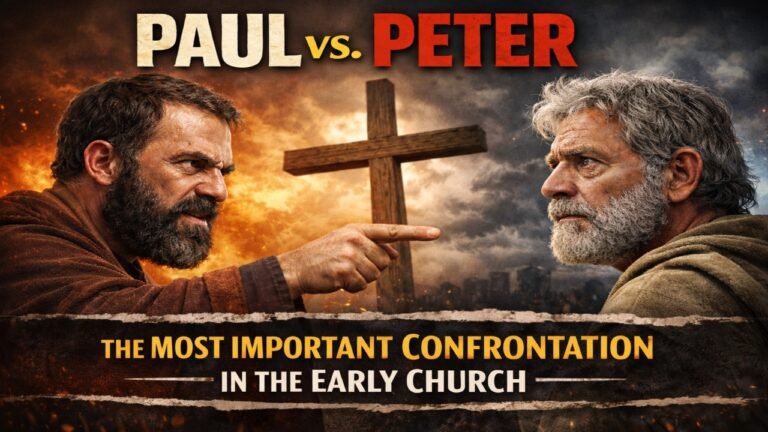
When Paul finally did visit Jerusalem, a full three years had passed—an absolute mathematical proof that his foundational theology was not shaped by the Judean community. He stayed with Cephas (Peter) for a brief fifteen days, a timeframe far too short for rabbinic retraining, and saw no other apostles except James, the Lord’s brother.
Following this brief encounter, Paul focused his ministry far away in Syria and Cilicia. He remained completely unknown by face to the churches of Judea. This precise chronological timeline provides vital insight into when this letter was composed. The details demonstrate that Galatians was written before the historic Jerusalem Council recorded in Acts 15. If the council had already taken place, Paul would not have needed to labor through personal timelines to prove his independent authority; he would have simply quoted the official council decree that freed Gentiles from circumcision.
Though the Judean assemblies had never seen Paul’s face, they did not reject him as an unvetted outsider. Instead, they kept hearing the remarkable report: “He who once persecuted us is now preaching the faith which he once tried to destroy.” And as a result, they directed all their praise where it belonged, glorifying God for the radical work of His sovereign grace.
Deep biblical study with insights from the original Greek and Hebrew texts.
Exploring the richness of Scripture through detailed study of the original biblical languages, grammar, historical background, and literary context to uncover the depth and precision of God’s revelation.
Verse-by-verse teaching rooted in the authority of Scripture.
Carefully walking through each passage in its biblical context, examining the meaning of the text line by line, with a commitment to faithful interpretation and the full authority of God’s Word.
Clear, serious exposition focused on truth, context, and sound doctrine.
Presenting Scripture with clarity and careful analysis, emphasizing accurate interpretation, theological depth, and the importance of understanding God’s Word within its proper historical and biblical context.
Christ-centered teaching that equips believers to understand and live God’s Word.
Focusing on the person and work of Jesus Christ while helping believers grow in spiritual maturity, biblical understanding, discernment, and faithful obedience to the truths of Scripture.
Exploring Scripture carefully, faithfully, and without compromise.
Approaching the Bible with reverence, precision, and integrity—seeking to handle the text honestly, remain faithful to its intended meaning, and uphold the truth of God’s Word without distortion or cultural pressure.
Stay Connected to New Studies
Stay connected with the latest Bible studies, verse-by-verse teachings, article updates, and new video content. Join the newsletter to receive thoughtful biblical teaching, Scripture insights, and ministry updates directly in your inbox.
Have more questions?
If you would like more information about the ministry, need assistance with the website or resources, or simply want to get in touch, feel free to send a message.

Paul vs. the False Brothers: How the Apostle Defended Freedom and Authority (Galatians 2:1-10)