Keep this lesson and your reflections together in My Study. Save it now, then return whenever you’re ready.
Download Today's Lesson
Download today's Lesson Outline, or create your FREE account to instantly unlock the complete Premium Study Package✓ Complete verse-by-verse commentary✓ Teacher's and student guides✓ Printable lesson outline✓ Quiz and answer key✓ Additional study resources when available.
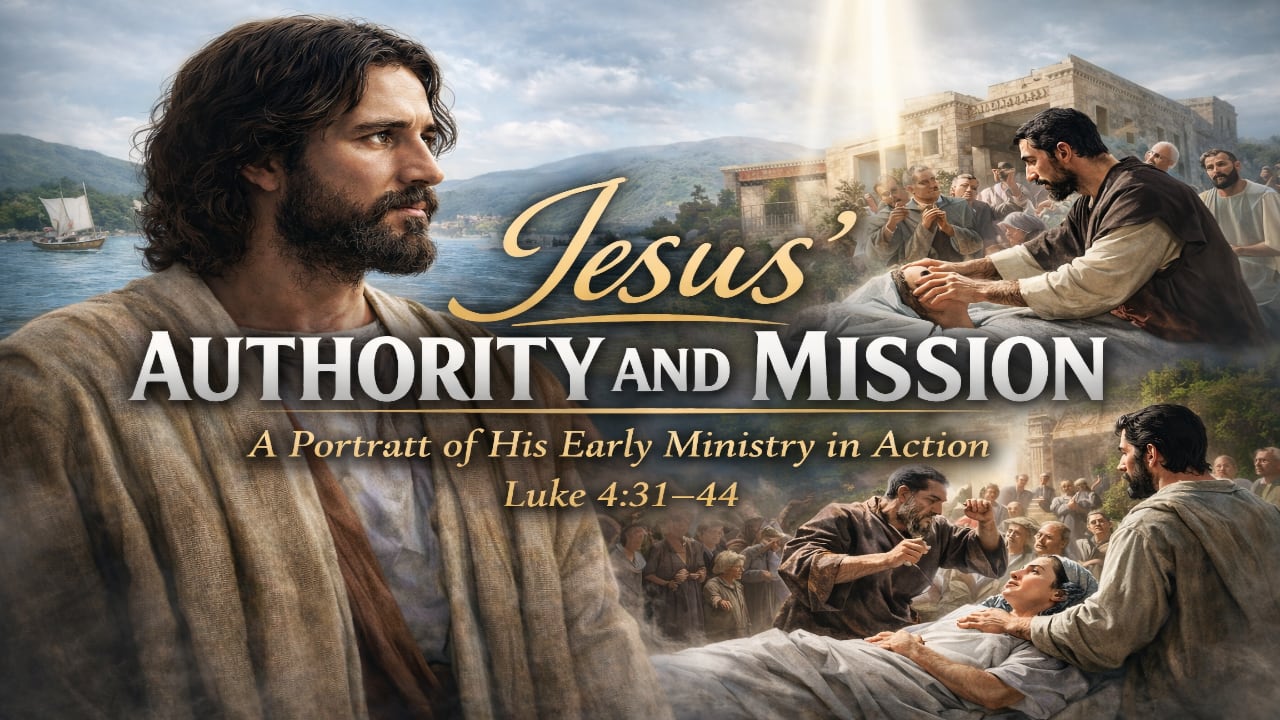
In Luke 4:14–30, Jesus formally began His earthly ministry by declaring Himself to be the fulfillment of Isaiah’s messianic prophecy. In the narrative that follows in Luke 4:31–44, the text transitions directly from declaration to demonstration. What was spoken in the synagogue at Nazareth is now verified practically through His words and works in Capernaum. This critical section provides a vivid portrait of early ministry in action, revealing that Christ’s authority is immediate, intrinsic, and unmatched.
Authoritative Teaching and Cosmic Supremacy (Luke 4:31–37)
Jesus establishes Capernaum as the geographic base for His Galilean ministry. Teaching in the synagogue on the Sabbath, His instruction instantly overwhelms the attendees. Luke records that the people were amazed, utilizing the Greek term exeplyssonto (ἐξεπλήσσοντο) to indicate being completely struck or disoriented by the weight of His delivery.
The structural reason for this shock is explicitly stated: “for His message was with authority.” This stood in absolute contrast to the contemporary scribes. First-century scribes relied entirely on derived, historical validation, constantly citing rabbinic traditions and human lineages to justify an interpretation. Jesus completely bypassed this mechanism. He quoted no external authorities because He was the authority. His teaching flowed directly from His divine identity and person.
This inherent supremacy immediately provokes defensive opposition from the spiritual realm. Present in the synagogue is a man possessed by an unclean demonic spirit. The entity gasps in terror (Ea!) and uses a classic Semitic idiom: “What do we have to do with You?” The demon then displays flawless theological awareness, utilizing the perfect tense verb oida (οἶδα) to express fixed, settled certainty: “I know exactly who You are—the Holy One of God.” The unclean realm understood His identity, His mission, and His future role as their ultimate Judge.
Jesus abruptly rebukes the entity and commands silence. Unlike contemporary human exorcists who relied on elaborate rituals, formulas, incantations, and processes, Jesus operates through no mechanical formulas. He simply speaks a bare verbal command. The obedience of creation is instantaneous. The demon flings the man down and exits without inflicting any physical harm, demonstrating a level of raw authority that leaves the multitudes completely astounded.
Complete Domestic Restoration and Intended Compassion (Luke 4:38–41)
Exiting the public synagogue, Jesus transitions into the domestic sphere of Simon Peter’s home, providing the important historical observation that Peter was married. Simon’s mother-in-law is suffering from a high, acute fever. Standing over her, Jesus rebukes the fever with the exact same raw authority used against the unclean spirit.
The healing is instantaneous and absolute. There is no period of medical convalescence, no gradual reduction of symptoms, and no residual weakness. She immediately rises and begins to actively serve the household, demonstrating that divine restoration results in immediate usefulness in ministry.
At sunset, marking the formal close of the Sabbath, a massive crowd with various unlimited diseases arrives at the house. Here, Luke notes a significant structural shift in Christ’s methodology: while He healed the fever by a bare verbal rebuke, He systematically heals the evening multitudes by personally laying His hands on each individual one of them. Jesus did not need to physically touch them; He chose to do so to demonstrate personal compassion and individual engagement.
Concurrently, demons are expelled from many, shouting, “You are the Son of God!” This marks an intentional advancement from the synagogue title, broadcasting His divine identity. Jesus strictly silences them. He refuses to accept or integrate validation originating from corrupt, deceptive spiritual sources, ensuring that the recognition of Christ remains divinely revealed rather than demonically announced.
Subordinating Miracles to the Preaching Mandate (Luke 4:42–44)
At daybreak, Jesus withdraws to a secluded, desolate place for prayer and separation. The multitudes actively hunt for Him, locate His position, and attempt to forcefully keep Him from leaving their region. However, the motivation of this crowd is entirely self-centered and consumer-driven. They are pursuing Christ for what He can physically provide—desiring a resident, localized miracle worker to eliminate their physical vulnerabilities and satisfy their temporal comfort.
Jesus firmly rejects their consumer-driven restrictions, delivering a definitive mission manifesto that establishes the primary parameter of His advent:
“I must preach the kingdom of God to the other cities also, for I was sent for this purpose.” (Luke 4:43)
This response establishes a critical theological boundary. Christ completely subordinates physical healing to the primary role of preaching. He did not enter human history to serve as a public healthcare reformer or a distributor of temporal advantages. The miracles of healing and exorcism were auxiliary; they were signs designed to validate and authenticate the message, but they did not constitute the ultimate purpose of His mission. The primary mission of Christ is the authoritative proclamation of the Kingdom of God, and He expands His preaching itinerary across regional boundaries to fulfill that eternal, spiritual purpose.
Core Reflections for Ministry
The Danger of Consumer Religion: The Capernaum multitudes valued what Jesus could do over who He was. Believers must consistently guard against reducing the King of Kings to a therapeutic utility designed to manage personal convenience rather than submitting to His spiritual mission.s.
The Source of Authority: True biblical authority is inherent and flows from the person of Christ, completely independent of human consensus or academic traditions.
The Insufficiency of Demonic Orthodoxy: The unclean spirits possessed flawless, accurate systematic theology regarding Christ’s identity, yet remained unregenerate. Intellectual accuracy can never substitute for a submissive, transformed heart.
Deep biblical study with insights from the original Greek and Hebrew texts.
Exploring the richness of Scripture through detailed study of the original biblical languages, grammar, historical background, and literary context to uncover the depth and precision of God’s revelation.
Verse-by-verse teaching rooted in the authority of Scripture.
Carefully walking through each passage in its biblical context, examining the meaning of the text line by line, with a commitment to faithful interpretation and the full authority of God’s Word.
Clear, serious exposition focused on truth, context, and sound doctrine.
Presenting Scripture with clarity and careful analysis, emphasizing accurate interpretation, theological depth, and the importance of understanding God’s Word within its proper historical and biblical context.
Christ-centered teaching that equips believers to understand and live God’s Word.
Focusing on the person and work of Jesus Christ while helping believers grow in spiritual maturity, biblical understanding, discernment, and faithful obedience to the truths of Scripture.
Exploring Scripture carefully, faithfully, and without compromise.
Approaching the Bible with reverence, precision, and integrity—seeking to handle the text honestly, remain faithful to its intended meaning, and uphold the truth of God’s Word without distortion or cultural pressure.
Stay Connected to New Studies
Stay connected with the latest Bible studies, verse-by-verse teachings, article updates, and new video content. Join the newsletter to receive thoughtful biblical teaching, Scripture insights, and ministry updates directly in your inbox.
Have more questions?
If you would like more information about the ministry, need assistance with the website or resources, or simply want to get in touch, feel free to send a message.