Download today's Lesson Outline, or create your FREE account to instantly unlock the complete Premium Study Package✓ Complete verse-by-verse commentary✓ Teacher's and student guides✓ Printable lesson outline✓ Quiz and answer key✓ Additional study resources when available.
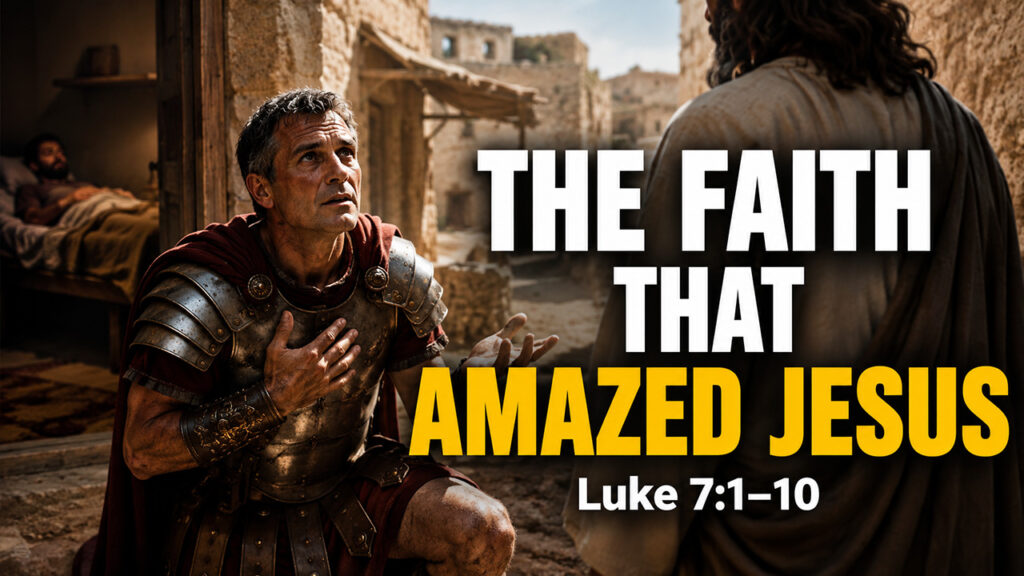
In the narrative architecture of the third Gospel, Luke 7:1-10 occupies a pivotal theological nexus. Often treated primarily as a standard narrative of physical healing, a precise exegetical examination reveals that the physical restoration of the centurion’s slave is recounted with profound, almost clinical brevity. The structural emphasis of the Holy Spirit rests firmly upon the character of the centurion’s faith, the absolute sovereignty of the Messiah’s word, and the public contrast drawn between this unexpected Gentile outsider and the nation of Israel.
The Boundary of the Sermon
The passage opens with definitive completion terminology: “When He had completed all His words in the hearing of the people, He entered Capernaum.” This phrasing signals a distinct literary and theological seam. The great discourse of Luke 6 concerning the ethical obligations of kingdom citizens—marked by radical mercy, love for adversarial forces, and accurate self-examination—has concluded. Luke transitions here from the instruction of the kingdom to a live demonstration of its power and unexpected expansion. Capernaum becomes the setting where covenantal boundaries are exposed as fluid, showing that spiritual reality is not determined by biological or cultural heritage, but by absolute trust in the word of God.
The Paradox of Worthiness
When the Roman officer discovers that his highly valued slave is on the verge of death, he initiates an approach to Christ that uncovers a massive structural tension in religious thought. He enlists respected Jewish elders to act as his intermediaries. These elders approach the Messiah with an appeal grounded entirely in a transactional model of human merit. They plead earnestly, asserting that the officer is distinctly “worthy” of divine intervention because he loves the Jewish nation and personally financed the construction of the local synagogue.
However, as the Messiah approaches the imperial quarters, the centurion sends a second delegation with a message that fundamentally dismantles the elders’ calculation. He declares explicitly: “Lord, do not trouble Yourself further, for I am not worthy for You to come under my roof.” This striking contrast highlights the core nature of biblical faith. The religious insiders calculated access based on human benevolence and transactional duty; the Gentile outsider calculated access based entirely on personal unworthiness and sovereign grace.
Absolute Sovereign Authority
The apex of the centurion’s faith is found in his operational understanding of authority. Drawing directly from his professional framework within the Roman military command structure, he reasons from the lesser to the greater. If a human officer under delegated authority can speak a singular word and command immediate compliance from distant soldiers, then the Messiah possesses an ultimate, underived authority to simply command unseen realities, disease, and distance with a spoken word. He does not request a physical ritual, a dramatic sign, or personal proximity; he recognizes that the bare word of Christ is entirely sufficient.
Hearing this confession, the incarnate Christ marvels—an authentic human experience of amazement within His complex incarnate consciousness—and turns to the accompanying crowd to issue a sharp covenantal reprimand: “I say to you, not even in Israel have I found such great faith.” The subsequent physical restoration of the servant stands as the definitive vindication of the centurion’s humble confidence, foreshadowing the radical global movement of grace toward the nations that marks the remaining historical trajectory of Luke-Acts.
Deep biblical study with insights from the original Greek and Hebrew texts.
Exploring the richness of Scripture through detailed study of the original biblical languages, grammar, historical background, and literary context to uncover the depth and precision of God’s revelation.
Verse-by-verse teaching rooted in the authority of Scripture.
Carefully walking through each passage in its biblical context, examining the meaning of the text line by line, with a commitment to faithful interpretation and the full authority of God’s Word.
Clear, serious exposition focused on truth, context, and sound doctrine.
Presenting Scripture with clarity and careful analysis, emphasizing accurate interpretation, theological depth, and the importance of understanding God’s Word within its proper historical and biblical context.
Christ-centered teaching that equips believers to understand and live God’s Word.
Focusing on the person and work of Jesus Christ while helping believers grow in spiritual maturity, biblical understanding, discernment, and faithful obedience to the truths of Scripture.
Exploring Scripture carefully, faithfully, and without compromise.
Approaching the Bible with reverence, precision, and integrity—seeking to handle the text honestly, remain faithful to its intended meaning, and uphold the truth of God’s Word without distortion or cultural pressure.
Stay Connected to New Studies
Stay connected with the latest Bible studies, verse-by-verse teachings, article updates, and new video content. Join the newsletter to receive thoughtful biblical teaching, Scripture insights, and ministry updates directly in your inbox.
Have more questions?
If you would like more information about the ministry, need assistance with the website or resources, or simply want to get in touch, feel free to send a message.