Download today's Lesson Outline, or create your FREE account to instantly unlock the complete Premium Study Package✓ Complete verse-by-verse commentary✓ Teacher's and student guides✓ Printable lesson outline✓ Quiz and answer key✓ Additional study resources when available.
The historical account recorded in Luke 5:1–11 marks a profound, structural turning point in the earthly ministry of Jesus Christ. This passage moves significantly beyond a dramatic recording of a substantial commercial catch of fish. Rather, it operates as an intentional, divine revelation of the cosmic person of Jesus Christ designed to initiate the apostolic call of His first disciples. The central figure through whom this revelation unfolds is Simon Peter. Through a workplace crisis of professional failure, Christ systematically unveils His absolute authority over creation, His uncompromised holiness, and the radical nature of true discipleship.
The Acoustic Platform and the Empty Nets (Luke 5:1–3)
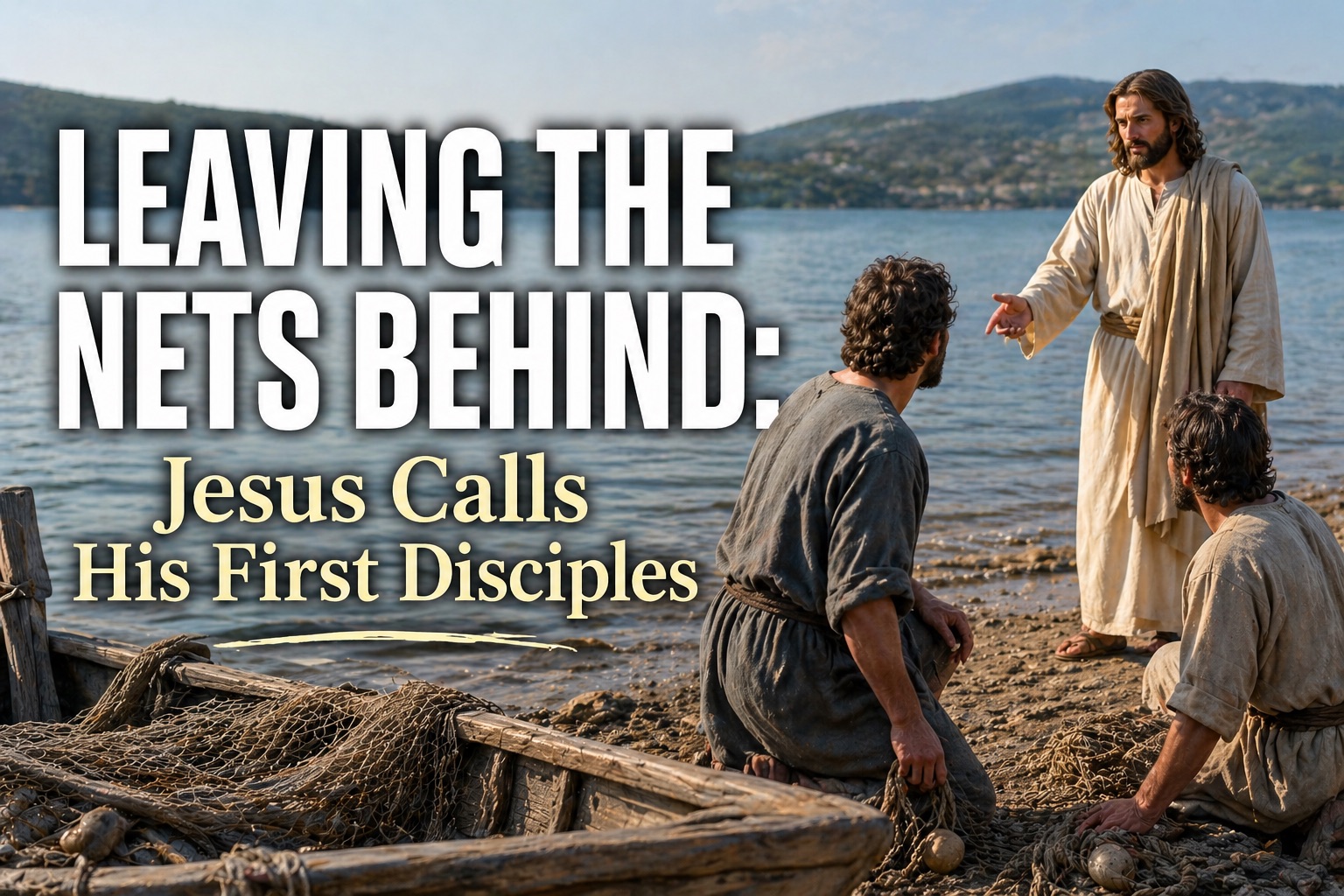
The setting opens along the shore of the Lake of Gennesaret, widely known as the Sea of Galilee, where massive crowds are actively pressing around Jesus to hear the definitive Word of God. This scene connects directly to the close of Luke 4, where Christ declared His mandatory, non-negotiable purpose to preach the kingdom of God in other places also. Jesus’ ministry was fundamentally a preaching ministry, and the expanding crowds validated that mandate.
Seeing two empty boats docked at the edge of the lake, Jesus observes that the fishermen have exited them and are actively washing their nets. This small detail is historically critical. Commercial fishing on the Sea of Galilee traditionally took place at night because the fish rose closer to the surface during cooler hours. By daytime, as morning temperatures increased, the fish descended deeper into the thermal pockets of the water, making them entirely inaccessible to surface nets. These men were seasoned, highly experienced professionals who had executed proper protocol throughout the optimal hours, yet they had caught absolutely nothing. The washing of the nets was a meticulous process to clean out mud and vegetation to prevent decay, signaling absolute, frustrated closure to a failed workday.
Jesus requests entry into Simon’s vessel and asks him to put out a little way from the land, utilizing the boat as an authoritative teaching platform. This action demonstrates both wisdom and pastoral intentionality: it physically protected Jesus from the crushing weight of the crowds while leveraging the natural acoustics of the water to let His voice carry more effectively into the multitude. Notably, this was not Simon Peter’s first introduction to Jesus. Andrew had previously introduces Simon to Jesus, declaring, “We have found the Messiah”. Simon already respected Jesus deeply ; however, Luke 5 represents the vital moment where previous external information about Jesus crystallizes into an intimate, personal reality through a direct encounter.
Subordinating Human Expertise to the Divine Mandate (Luke 5:4–5)
Upon finishing His address to the public crowds, Jesus redirects His focus away from the multitude to address Simon personally, issuing a directive that completely defied human professional reason:
“Put out into the deep water and let down your nets for a catch.”
To an experienced fisherman, this command was entirely counter-intuitive. The optimal nighttime hours were over, the temperatures were rising, and the crew was utterly exhausted from hours of fruitless toil.
Simon’s response exposes the immediate internal tension between professional human intellect and the bare word of Christ:
“Master, we worked hard all night and caught nothing, but at Your word I will let down the nets.”
The word translated “Master” is Epistata (ἐπιστάτα), a uniquely Lukan expression that reflects deep reverence and the recognition of legitimate administrative command authority. To describe their labor, Simon relies on the Greek term kopiasantes, which carries the idea of laboring intensely to the point of complete weariness and exhaustion. They had deployed their maximum human capability and achieved total failure. Yet, Simon choices to subordinate his expertise, his fatigue, and his professional pride to the mandate of Christ. This absolute obedience “at Your word” becomes the mandatory portal through which divine sovereign revelation is unleashed.
The Sign of Creative Lordship (Luke 5:6–7)
The moment the nets are dropped into the deep midday waters, creation responds to its Maker. The disciples enclose a massive, overwhelming quantity of fish, causing their nets to experience immediate structural failure. The volume is so immense that they are forced to frantically signal to their corporate partners, James and John, in the adjacent vessel to come and assist them. Upon arrival, they load both boats to such an extreme capacity that both vessels begin to take on water and literally sink.
This miracle demonstrates far more than supernatural spatial clairvoyance or localized good fortune. Jesus commands creation itself, and the animal kingdom obeys His administrative will absolutely because creation belongs to Him. This is why the event must be properly understood as a sign. It points beyond the immediate commercial windfall to authenticate the absolute, divine nature of Christ. The sign forcefully proclaimed to Simon that every messianic claim he had previously heard concerning Jesus was entirely true.
The Crisis of Holiness and the Call to Discipleship (Luke 5:8–11)
When Simon Peter witnesses the sinking, asset-laden boats, his response is completely devoid of material excitement or commercial celebration. He is seized by a deep, theological terror and awe. Falling straight down at the knees of Jesus, he cries out:
“Go away from me Lord, for I am a sinful man!”
Peter’s reaction closely parallels the classic Old Testament prophetic calling template found in Isaiah 6. When the prophet Isaiah beheld the uncompromised glory of the Lord high and lifted up, the seraphim cried, “Holy, Holy, Holy,” and Isaiah’s immediate response was a crisis of personal ruin: “Woe is me, for I am ruined! Because I am a man of unclean lips”.
In exactly the same manner, the revelation of Christ’s divine power brings Peter face-to-face with absolute holiness. In that single moment, two realizations occur simultaneously: Peter suddenly understands who Jesus truly is, and he notes with painful clarity who he himself truly is. The holiness of Christ exposes the sinfulness of Peter. Notice also the critical shift in his vocabulary: he abandons the administrative title Epistata (Master/Supervisor) and addresses Jesus as Kyrie (κύριε)—Lord. He recognizes that he is not merely standing before a superior human teacher, but before One who possesses the sovereign power and purity belonging to God alone.
Jesus responds to this holy fear not with condemnation, but with a radical re-orientation of human purpose. He addresses Simon with the programmatic command: “Do not fear, from now on you will be catching men.” Christ transforms his identity, moving him from a commercial fisherman to an apostolic fisher of men, gathering human souls alive into the safety of the kingdom of God.
The response of the fishermen is absolute and historic. Bringing their boats to land, they leave everything behind—their largest career financial harvest, their equipment, their security, and their family infrastructure—to follow Him. The revelation of who Jesus was made all earthly security and material wealth appear utterly worthless by comparison. True discipleship requires total surrender, and the first disciples left their nets behind forever to follow the Messiah.
Core Reflections for the Website Post
The Portal of Human Failure (Kopiasantes): God frequently allows our independent human strategies and professional expertise to result in absolute emptiness. It is often at the precise end of our exhausted, human effort that we become ready to operate solely “at His word,” turning our professional bankruptcy into a platform for divine revelation.
The Disorientation of Divine Holiness: True contact with the person of Jesus never boosts human pride; it shatters self-righteousness. Like Isaiah, Peter shows us that an authentic encounter with the living God forces an immediate realization of personal sinfulness and complete unworthiness.
Leaving at the Peak of Abundance: The radical nature of their surrender is highlighted by its timing. They did not abandon the fishing industry because they were failing; they walked away from it at the moment of their ultimate peak financial success, proving that Christ is vastly more valuable than the greatest temporal security the world can provide.
Deep biblical study with insights from the original Greek and Hebrew texts.
Exploring the richness of Scripture through detailed study of the original biblical languages, grammar, historical background, and literary context to uncover the depth and precision of God’s revelation.
Verse-by-verse teaching rooted in the authority of Scripture.
Carefully walking through each passage in its biblical context, examining the meaning of the text line by line, with a commitment to faithful interpretation and the full authority of God’s Word.
Clear, serious exposition focused on truth, context, and sound doctrine.
Presenting Scripture with clarity and careful analysis, emphasizing accurate interpretation, theological depth, and the importance of understanding God’s Word within its proper historical and biblical context.
Christ-centered teaching that equips believers to understand and live God’s Word.
Focusing on the person and work of Jesus Christ while helping believers grow in spiritual maturity, biblical understanding, discernment, and faithful obedience to the truths of Scripture.
Exploring Scripture carefully, faithfully, and without compromise.
Approaching the Bible with reverence, precision, and integrity—seeking to handle the text honestly, remain faithful to its intended meaning, and uphold the truth of God’s Word without distortion or cultural pressure.
Stay Connected to New Studies
Stay connected with the latest Bible studies, verse-by-verse teachings, article updates, and new video content. Join the newsletter to receive thoughtful biblical teaching, Scripture insights, and ministry updates directly in your inbox.
Have more questions?
If you would like more information about the ministry, need assistance with the website or resources, or simply want to get in touch, feel free to send a message.