Keep this lesson and your reflections together in My Study. Save it now, then return whenever you’re ready.
Download Today's Lesson
Download today's Lesson Outline, or create your FREE account to instantly unlock the complete Premium Study Package✓ Complete verse-by-verse commentary✓ Teacher's and student guides✓ Printable lesson outline✓ Quiz and answer key✓ Additional study resources when available.
The natural drift of the human heart is toward the cold security of external religious performance. We easily find a false comfort in multiplying rules, drawing sharp lines, and constructing elaborate boundaries that allow us to measure our own righteousness while looking down upon others. This lethal spiritual pathology is not a modern invention; it was the defining crisis of the first-century religious elite who confronted Jesus Christ in the pages of the Gospels.
In Luke 5:27-39, the Holy Spirit curates a decisive theological and covenantal transition in the ministry of Jesus Christ. This section moves systematically from the scandalous calling of a despised tax collector to a high-confrontation debate regarding ritual practices. The entire narrative revolves around one central issue: the absolute inability of the traditional religious establishment to recognize and receive the Messiah and the new covenant realities He came to establish.
I. The Scandalous Call of the Outcast (Luke 5:27-28)
“And after that He went out and noticed a tax collector named Levi sitting in the tax booth, and He said to him, ‘Follow Me.’ And he left everything behind, and got up and began to follow Him.”
The narrative opens with Jesus passing by a customs toll station and noticing a tax collector named Levi, elsewhere identified as Matthew, the future apostle and evangelist. To understand the jaw-dropping nature of this interaction, one must look at the historical reality of first-century Judea. Tax collectors were among the most intensely hated individuals in Jewish society. As Jews employed by the Roman government to extract taxes from their fellow countrymen, they were viewed as treacherous political collaborators and social traitors. Furthermore, they were infamous for extortion, routinely inflating tax demands to enrich themselves.
Jewish society viewed tax collectors as ceremonially and morally defiled. Rabbinic tradition categorized them alongside Gentiles and outcasts, explicitly declaring in the Mishnah (Tohorot7:6) that if a tax collector entered a household, the entire house became ceremonially unclean.
Consequently, Christ’s direct command to Levi represents a scandalous shattering of cultural paradigms. A respected rabbi would normally gather morally pristine disciples; Jesus deliberately summons a man regarded as spiritually bankrupt and beyond hope.
Levi’s response is immediate, complete, and definitive. He leaves everything behind—abandoning his wealth, his lucrative career, and his earthly security. This total surrender underlines the absolute authority of the Messiah’s call, which instantly overrides all earthly attachments.
II. Reclining with the Sick (Luke 5:29-32)
“And Levi gave a big reception for Him in his house; and there was a great crowd of tax collectors and other people who were reclining at the table with them. The Pharisees and their scribes began grumbling at His disciples, saying, ‘Why do you eat and drink with the tax collectors and sinners?'”
To celebrate his definitive separation from his former identity, Levi hosts a massive banquet in his home. Naturally, his guest list consists primarily of his old associates—other tax collectors and individuals broadly categorized as “sinners” or socially degenerate.
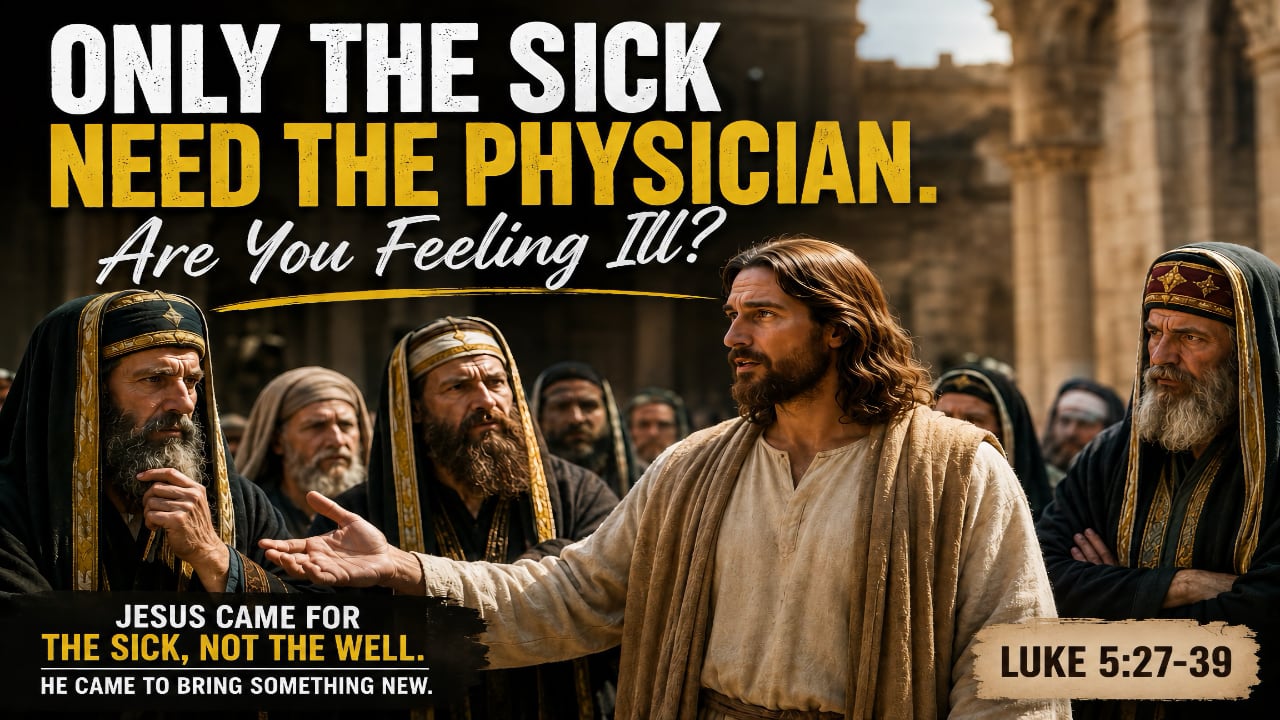
The sight of a holy teacher reclining at a banquet table with notorious outcasts provokes immediate opposition from the Pharisees and their scribes. Seeking to undermine Christ’s influence, they direct their criticism toward His disciples, demanding, “Why do you eat and drink with them?”In their legalistic framework, holiness was maintained exclusively through physical isolation from the morally compromised. They viewed sinners as contaminating influences, completely missing the redemptive heart of God’s character.
Jesus answers their structural hostility with a penetrating medical metaphor that reframes the entire purpose of His ministry:
“It is not those who are well who need a physician, but those who are sick. I have not come to call the righteous but sinners to repentance.”
With this single declaration, Christ defines His messianic mission as fundamentally redemptive, evangelistic, and transformative. He does not associate with sinners to endorse or indulge in social fellowship, but to administer spiritual healing to sin-sick souls.
Simultaneously, His response carries a profound layer of divine irony and indirect rebuke. By assuming themselves to be spiritually whole and structurally righteous, the Pharisees effectively disqualify themselves from receiving mercy. Self-righteousness blinds the soul to its own critical need, blocking access to the only Physician who can grant true forgiveness and internal restoration.
III. The Presence of the Bridegroom (Luke 5:33-35)
“And they said to Him, ‘The disciples of John often fast and offer prayers, the disciples of the Pharisees also do the same, but Yours eat and drink.’ And Jesus said to them, ‘You cannot make the attendants of the bridegroom fast while the bridegroom is with them, can you?'”
Shifting their attack from the banquet table to ritual practices, the religious leaders cross-examine Jesus regarding the behavior of His followers. In their theological framework, spirituality was measured by visible, external mourning and ritual fasting. They strategically attempt to use the respected reputation of John the Baptist’s followers to shame Christ’s disciples for their apparent lack of religious seriousness.
Jesus counters by utilizing vibrant wedding imagery. In Jewish culture, fasting expressed sorrow, heavy longing, and earnest anticipation for God’s dramatic intervention or the arrival of the Messiah. Christ’s answer is revolutionary: the longing is over because the target of that longing is standing in their midst. The Bridegroom has arrived, transforming the spiritual atmosphere from legalistic mourning to covenant celebration.
However, Jesus immediately inserts a sobering eschatological prophecy:
“But the days will come; and when the bridegroom is taken away from them, then they will fast in those days.”
Jesus is looking forward toward His future crucifixion, resurrection, and heavenly ascension. In this current age of the church—characterized by the temporary physical absence of the Savior—the posture of fasting and longing returns, but it is anchored in the secure joy of a accomplished redemption.
IV. The Parable of the New Wine (Luke 5:36-39)
Jesus seals His defense by delivering a twin parable concerning garments and wineskins, illustrating the absolute incompatibility between the old religious framework and the new covenant realities He establishes.
“No one tears a piece of cloth from a new garment and puts it on an old garment… And no one puts new wine into old wineskins; otherwise the new wine will burst the skins and it will be spilled out, and the skins will be ruined. But new wine must be put into fresh wineskins.”
In this vivid illustration, the old garment and old wineskins symbolize the old covenant structures, customs, and external religious traditions as interpreted through the lens of Pharisaic legalism. The new patch and new wine represent the transformative teachings of Christ, the new covenant, and the internal work of regeneration.
Jesus did not come to patch up, repair, or modify a broken, external legal system; He came to fulfill it and establish something entirely new, in direct fulfillment of the prophetic promise of Jeremiah 31:31. The hardened, self-righteous hearts of the religious elite are like old wineskins—inflexible and incapable of containing the dynamic, expanding power of the gospel.
Verse 39 exposes their internal pathology perfectly:
“And no one, after drinking old wine wishes for new; for he says, ‘The old is good enough.'”
Comfortable with their traditions and external morality, they claim they need nothing further, completely rejecting the very messianic fulfillment God promised. The new covenant demands completely regenerated, transformed hearts that surrender unconditionally to the person and supreme authority of Jesus Christ.
Deep biblical study with insights from the original Greek and Hebrew texts.
Exploring the richness of Scripture through detailed study of the original biblical languages, grammar, historical background, and literary context to uncover the depth and precision of God’s revelation.
Verse-by-verse teaching rooted in the authority of Scripture.
Carefully walking through each passage in its biblical context, examining the meaning of the text line by line, with a commitment to faithful interpretation and the full authority of God’s Word.
Clear, serious exposition focused on truth, context, and sound doctrine.
Presenting Scripture with clarity and careful analysis, emphasizing accurate interpretation, theological depth, and the importance of understanding God’s Word within its proper historical and biblical context.
Christ-centered teaching that equips believers to understand and live God’s Word.
Focusing on the person and work of Jesus Christ while helping believers grow in spiritual maturity, biblical understanding, discernment, and faithful obedience to the truths of Scripture.
Exploring Scripture carefully, faithfully, and without compromise.
Approaching the Bible with reverence, precision, and integrity—seeking to handle the text honestly, remain faithful to its intended meaning, and uphold the truth of God’s Word without distortion or cultural pressure.
Stay Connected to New Studies
Stay connected with the latest Bible studies, verse-by-verse teachings, article updates, and new video content. Join the newsletter to receive thoughtful biblical teaching, Scripture insights, and ministry updates directly in your inbox.
Have more questions?
If you would like more information about the ministry, need assistance with the website or resources, or simply want to get in touch, feel free to send a message.