Download today's Lesson Outline, or create your FREE account to instantly unlock the complete Premium Study Package✓ Complete verse-by-verse commentary✓ Teacher's and student guides✓ Printable lesson outline✓ Quiz and answer key✓ Additional study resources when available.
In this foundational text, Jesus shifts His ministry from widespread public interactions to the intentional consolidation of His kingdom ambassadors. This passage outlines a critical progression from private devotion to public commission, providing an enduring template for biblical discipleship and leadership.
I. The Private Foundation (Luke 6:12)
Before a single administrative action is taken or a single name is announced, the Lord Jesus withdraws from localized populist demands and ascends the mountain to pray.
The Historical Seam: Luke utilizes the phrase egeneto de (“Now it happened in those days”) to signal a critical transition in redemptive history.
Perfect Dependency: The sinless, incarnate Son of God spent the entire night in uninterrupted communion with the Father (ēn dianyktereuōn en tē proseuchē tou theou). Operating in His uncompromised humanity, Jesus models that momentous ministry steps must be birthed out of deep, sustained dependency upon God—serving as a severe indictment against modern ministerial prayerlessness.
II. The Sovereign Selection (Luke 6:13–16)
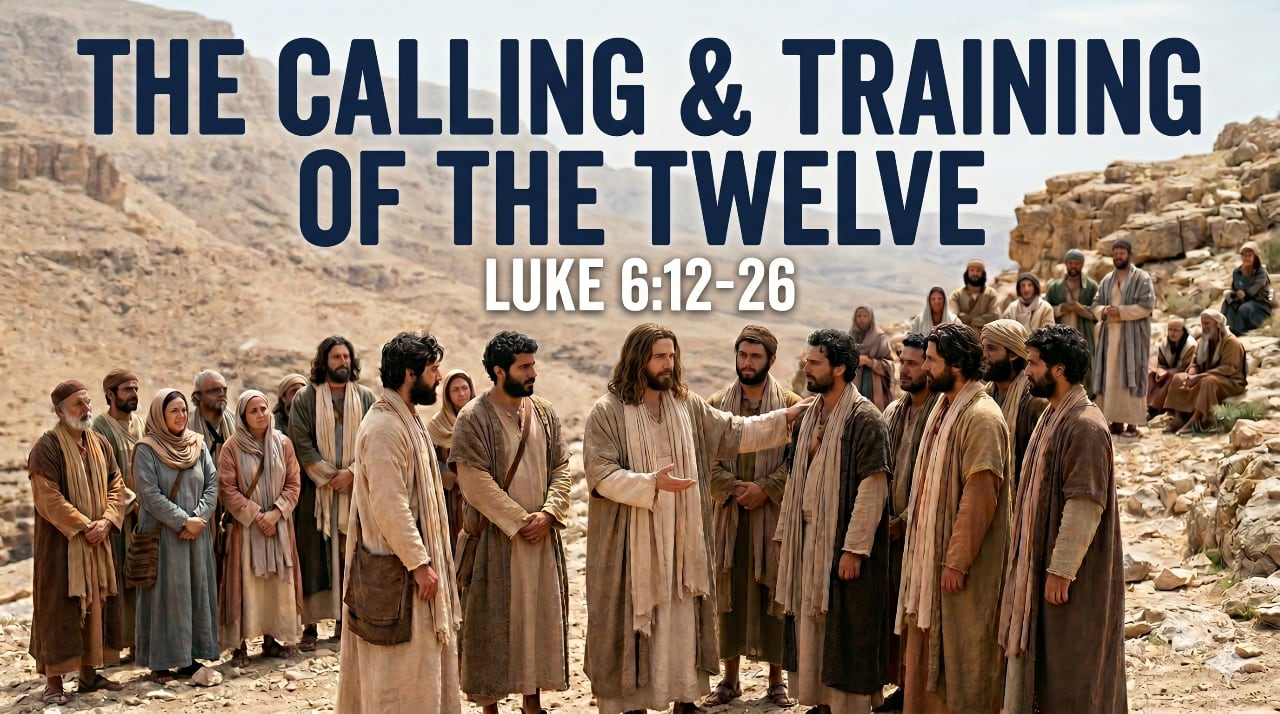
At dawn, Jesus gathers the broad pool of His disciples (mathētai) and purposefully executes a sovereign, narrowing sifting to choose exactly twelve individuals.
Redemptive-Historical Signposts: The number twelve directly mirrors the patriarchal tribes of ancient Israel, visually declaring that Jesus is constructing the renewed, true Israel around His own person.
Official Proxies: He officially names them “apostles” (apostoloi), denoting commissioned envoys sent forth with the fully delegated legal authority of the Sender. Their eyewitness testimony forms the permanent doctrinal baseline of the global church.
Supernatural Unity: The composition of the Twelve highlights the radical nature of kingdom community. Christ brings together natural, political enemies—such as Matthew (a former Roman-collaborating tax collector) and Simon the Zealot (a fierce anti-Roman nationalist)—into an unbreakable spiritual brotherhood.
The Traitor Present: The list soberingly terminates with Judas Iscariot, a permanent warning that maximal external proximity to the exposition of truth and church leadership does not guarantee inner conversion.
III. The Demonstration Arena (Luke 6:17–19)
Descending to a level place (topou pedinou), Jesus places the newly ordained Twelve into an intensive operational laboratory where the classroom and the clinic merge.
Word and Deed: A massive, diverse multitude converges to hear His authoritative verbal instruction and to be healed of systemic diseases. The miracles objectively validate the messianic message, while the message explains the theological depth of the miracles.
The Pedagogical Baseline: Luke uses the imperfect passive verb etherapeuonto to describe an ongoing, cascading wave of continuous supernatural restoration. Before the Twelve are ever sent out to execute ministry, they are forced to observe the Master executing it in real time. Ministry must be visually demonstrated before it is operationally delegated.
IV. The Internal Character of Kingdom Citizens (Luke 6:20–23)
Jesus turns His physical gaze toward the disciples and delivers the absolute spiritual parameters that govern the citizens of His kingdom, initiating the discourse with the verdict of “Blessed” (makarioi).
The Objective Verdict:Makarios must be rescued from superficial concepts of subjective happiness; it is a formal forensic verdict of divine approval and covenant security granted by God, completely independent of shifting earthly circumstances.
Spiritual Poverty (ptōchos): This refers to absolute moral bankruptcy before a holy God. It is the comprehensive recognition that one possesses zero internal righteousness, driving the broken soul to find refuge exclusively in the sufficiency of Christ.
The Spiritual Chain: This recognition triggers a desperate starvation for an external, alien righteousness (hunger now), which is completely satisfied by Christ’s imputed obedience. It manifests as an awakened godly sorrow over personal corruption and a fractured world (weeping now), which is answered by certain, eschatological joy.
Persecution for the Name: Jesus maps the inevitable collision with a hostile world: hatred, social ostracism, insult, and defamation. This persecution is only blessed if sustained strictly “for the sake of the Son of Man” (heneka tou huiou tou anthrōpou). Disciples are commanded to leap for joy, knowing their reward is secure in heaven, aligning them with the historical lineage of the prophets.
V. The External Warning against Self-Sufficiency (Luke 6:24–26)
The discourse shifts with dramatic prophetic weight as Jesus transitions from blessing to condemnation, pronouncing an intense cry of lamentation and impending divine judgment: “Woe” (ouai).
The Exposure of False Assurance: Just as the Beatitudes must not be distorted by economic reductionism, the Woes target internal spiritual self-sufficiency. The “rich” and “well-fed” are those deluded by illusions of their own moral goodness, religious traditions, or societal standing. Stuffed with self-assurance, they have received their comfort in full within this temporary world, guaranteeing ultimate eternal starvation before the holiness of God.
The Peril of Popularity: Jesus pronounces a severe woe upon those of whom “all men speak well.” Universal cultural approval and popularity from an unregenerate world are the definitive, permanent badges of the false prophet (pseudoprophētai). True faithfulness to the message of the King will inevitably provoke a head-on collision with the sin of a culture.
VI. Pastoral Reflection & Spiritual Diagnostics
The principles embedded in this text function as permanent diagnostic categories to measure our ongoing spiritual health. We must consistently subject our souls to specific, non-negotiable cross-examinations:
The Diagnostic of Poverty: Do I live in a daily, acute awareness of my absolute spiritual bankruptcy apart from the continuous, intervening grace of Jesus Christ, or have I drifted into a state of spiritual smugness, relying on past achievements or religious longevity?
The Diagnostic of Hunger: Am I actively starving for true holiness and the sustained righteousness of Christ, or have I become full of myself, content with external moral polish and human reputation?
The Diagnostic of Sorrow: Does my heart genuinely mourn over the presence of sin in my life and the agonizing brokenness of this fallen world, or have I become comfortably domesticated by the cheap entertainments and superficial laughter of this present age?
The Diagnostic of Approval: Am I completely willing to suffer social isolation or the assassination of my character for an uncompromised commitment to the truth of Jesus Christ, or am I secretly managing my speech to secure the validation and approval of men?
Conclusion
Luke 6:12–26 leaves the church with an unavoidable divergence. There are ultimately only two paths heading toward two unalterable eternal destinies. One path belongs to those who recognize their profound spiritual need, cast down their pride, and come to Jesus Christ alone for everything. The other path belongs to those who reject the Messiah in self-sufficiency, clinging tightly to their personal morality, wealth, and cultural applause. We must reject the lethal illusions of self-reliance, anchor our souls exclusively in the righteousness of Christ, and advance His truth with absolute clarity.
Deep biblical study with insights from the original Greek and Hebrew texts.
Exploring the richness of Scripture through detailed study of the original biblical languages, grammar, historical background, and literary context to uncover the depth and precision of God’s revelation.
Verse-by-verse teaching rooted in the authority of Scripture.
Carefully walking through each passage in its biblical context, examining the meaning of the text line by line, with a commitment to faithful interpretation and the full authority of God’s Word.
Clear, serious exposition focused on truth, context, and sound doctrine.
Presenting Scripture with clarity and careful analysis, emphasizing accurate interpretation, theological depth, and the importance of understanding God’s Word within its proper historical and biblical context.
Christ-centered teaching that equips believers to understand and live God’s Word.
Focusing on the person and work of Jesus Christ while helping believers grow in spiritual maturity, biblical understanding, discernment, and faithful obedience to the truths of Scripture.
Exploring Scripture carefully, faithfully, and without compromise.
Approaching the Bible with reverence, precision, and integrity—seeking to handle the text honestly, remain faithful to its intended meaning, and uphold the truth of God’s Word without distortion or cultural pressure.
Stay Connected to New Studies
Stay connected with the latest Bible studies, verse-by-verse teachings, article updates, and new video content. Join the newsletter to receive thoughtful biblical teaching, Scripture insights, and ministry updates directly in your inbox.
Have more questions?
If you would like more information about the ministry, need assistance with the website or resources, or simply want to get in touch, feel free to send a message.