Download today's Lesson Outline, or create your FREE account to instantly unlock the complete Premium Study Package✓ Complete verse-by-verse commentary✓ Teacher's and student guides✓ Printable lesson outline✓ Quiz and answer key✓ Additional study resources when available.
Mercy, Restoration, and the Authority of the Son of Man
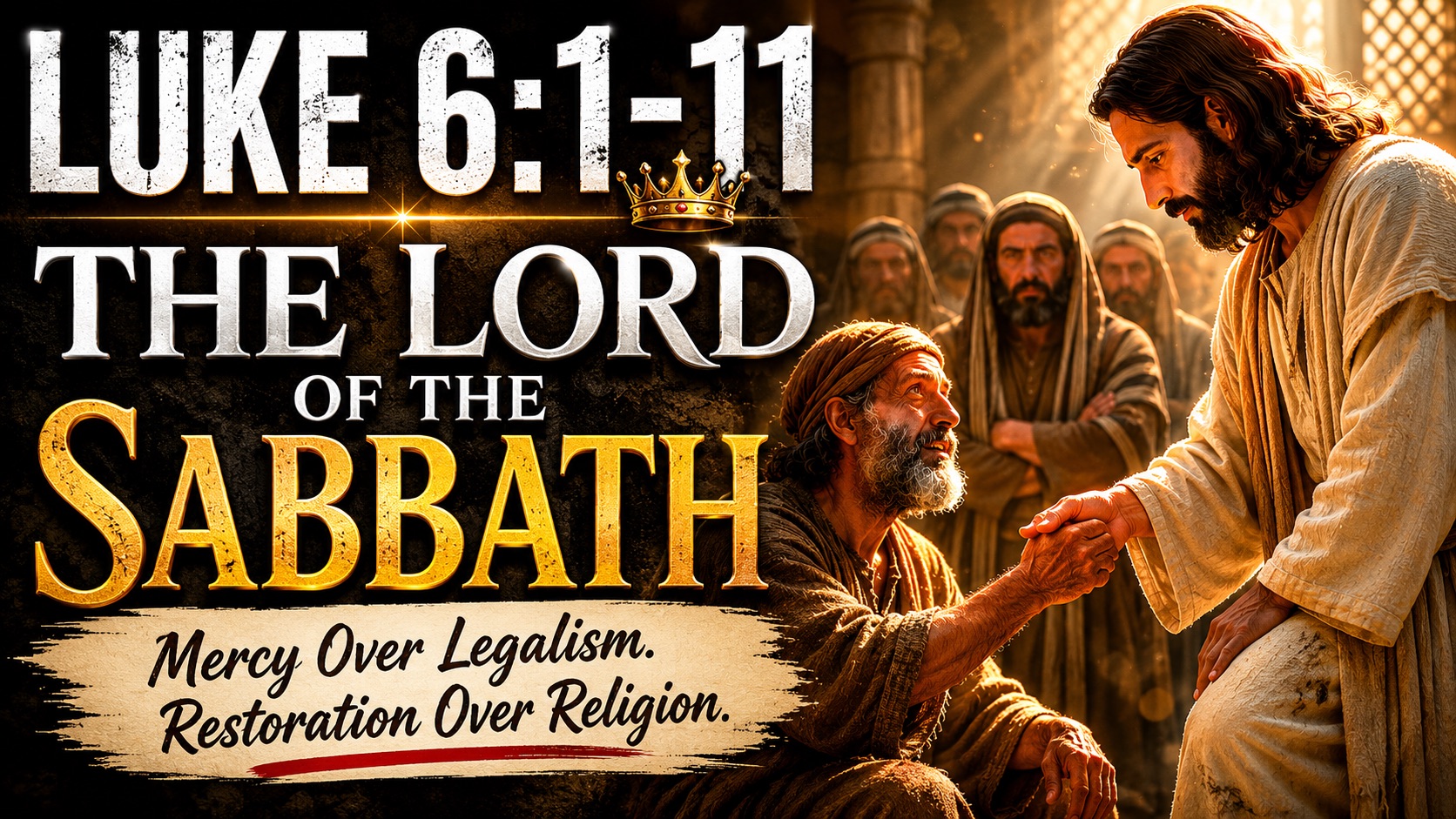
Luke 6:1–11 presents two connected Sabbath controversies that function together as a unified revelation of the identity and authority of Jesus Christ. These are not isolated events merely about disputes over religious customs. Luke intentionally arranges these narratives to demonstrate that Jesus is the authoritative interpreter of the Sabbath because He is the divine Son of Man, the Lord of the Sabbath itself. The section progressively exposes the spiritual blindness and hardened unbelief of the religious leaders while simultaneously revealing Christ’s divine authority, mercy, wisdom, and restorative purpose.
The passage unfolds in two movements. In the first, Jesus defends His disciples for plucking grain on the Sabbath. In the second, He heals a man with a withered hand on the Sabbath in the synagogue. Together, these accounts build a theological argument: the Sabbath was never intended to burden humanity with oppressive legalism, but to serve life, restoration, mercy, and ultimately point to the spiritual rest found in Christ Himself.
Luke writes:
“Now it happened that as He was passing through some grainfields on a Sabbath, His disciples were picking and eating the heads of grain, rubbing them in their hands.” — Luke 6:1
The disciples were not stealing. Deuteronomy 23:25 permitted travelers to pluck grain by hand from a neighbor’s field for immediate hunger. The issue was not theft. The issue, according to the Pharisees, was Sabbath violation.
The disciples were accused because they were “picking,” “rubbing,” and “eating” grain. The religious leaders interpreted these actions as forms of harvesting, threshing, and preparing food. Yet this accusation did not arise from the Mosaic Law itself. Rather, it arose from the extensive oral traditions that had developed around Sabbath observance.
By the first century, the Jewish religious system had constructed an elaborate network of Sabbath regulations designed to create what rabbis called a “hedge around the law.” The idea was that if one stayed far enough away from actual violations, the law itself would never be broken. These traditions eventually became codified in the Mishnah, particularly in the tractate Shabbat, which identified thirty-nine categories of prohibited work. The later Talmud expanded these interpretations even further through centuries of rabbinic commentary and debate.
Thus, when the Pharisees asked:
“Why do you do what is not lawful on the Sabbath?” — Luke 6:2
they were not accusing the disciples of violating explicit Scripture. They were accusing them of violating rabbinic interpretation and oral tradition. This is critical to understanding the confrontation. The dispute is fundamentally about authority. Who has the right to define the meaning and intent of the Sabbath? The Pharisees believed that authority belonged to their interpretive tradition. Jesus demonstrates that authority belongs to Him.
Jesus responds by appealing to Scripture:
“Have you never read what David did when he was hungry, he and those who were with him?” — Luke 6:3
Christ points them to 1 Samuel 21. David, while fleeing from Saul, entered the house of God and received the consecrated bread, also called the bread of the Presence. According to Levitical law, this bread was reserved exclusively for the priests. Yet in a moment of genuine human need, the priest gave the bread to David and his companions.
Jesus’ argument is profound. If David—the anointed king—could receive consecrated bread in a situation of necessity without condemnation, then how much more could the disciples of the Messiah satisfy hunger on the Sabbath?
The point is not that the law was meaningless. The point is that the law was never intended to function apart from mercy, compassion, and the true purposes of God. Human need was not subordinate to cold ritualism. The Pharisees had elevated tradition above mercy and regulation above compassion.
In Mark’s parallel account, Jesus references Abiathar in connection with this event (Mark 2:26). The historical narrative in 1 Samuel 21 identifies Ahimelech as the acting priest at the time. Abiathar was Ahimelech’s son and later became the more prominent high priest during David’s reign. Jesus’ reference therefore functions as an identification of the broader historical period associated with Abiathar rather than a historical error. The issue is not confusion, but contextual identification.
The climax of the first account arrives in Luke 6:5:
“And He was saying to them, ‘The Son of Man is Lord of the Sabbath.’”
This statement is staggering in its implications.
Jesus identifies Himself as “the Son of Man,” a title deeply rooted in Daniel 7:13–14:
“And behold, with the clouds of heaven One like a Son of Man was coming… And to Him was given dominion, glory and a kingdom, that all the peoples, nations, and men of every language might serve Him.”
This is not merely a title emphasizing humanity. In Daniel, the Son of Man is a divine messianic figure who receives everlasting dominion and worship-like service from the nations. Jesus repeatedly uses this title of Himself to reveal both His messianic identity and divine authority.
Thus, when Jesus declares Himself “Lord of the Sabbath,” He is claiming authority over an institution established by God Himself. The Sabbath belonged to God because God instituted it. Therefore, for Jesus to claim lordship over the Sabbath is an implicit declaration of deity.
Colossians 1:15 later describes Christ as:
“the firstborn of all creation.”
The term prototokos does not mean Christ was created. Rather, it speaks of supremacy, rank, and preeminence. Christ stands above creation because He is its Creator. As such, He stands above the law because He is the divine Lawgiver incarnate.
The second Sabbath controversy in Luke 6:6–11 intensifies these themes.
“On another Sabbath He entered the synagogue and was teaching; and there was a man there whose right hand was withered.” — Luke 6:6
Luke specifically notes that it was the man’s right hand, likely emphasizing the severity of the disability. In the ancient world, a damaged right hand could devastate one’s ability to work and survive.
The setting is strategic. Jesus is teaching publicly in the synagogue. The scribes and Pharisees are watching carefully:
“The scribes and the Pharisees were watching Him closely to see if He healed on the Sabbath, so that they might find reason to accuse Him.” — Luke 6:7
Their concern is not the suffering man. Their concern is building a legal case against Jesus.
This reveals the terrifying effect of religious legalism upon the human heart. They had become so consumed with preserving their interpretive system that they could observe human suffering without compassion. Their traditions mattered more to them than restoration.
It is possible the man himself was intentionally positioned there as bait for Jesus. The text does not explicitly say this, but the context strongly suggests a deliberate trap. They anticipated Christ’s compassion and intended to weaponize mercy against Him.
Yet Jesus completely reverses the situation.
“But He knew what they were thinking…” — Luke 6:8
This is another revelation of Christ’s divine nature. Scripture repeatedly teaches that God alone fully knows the hearts of men. Psalm 139 declares that God searches and knows the thoughts of humanity. Yet here Jesus possesses immediate and complete knowledge of their internal reasoning.
This is not merely sharp intuition. This is divine omniscience breaking through the narrative.
Jesus commands the man:
“Get up and come forward!”
Christ intentionally places the suffering man in the center of the synagogue. The confrontation becomes public, unavoidable, and revelatory.
Then Jesus asks:
“I ask you, is it lawful to do good or to do harm on the Sabbath, to save a life or to destroy it?” — Luke 6:9
The brilliance of this question cannot be overstated.
Jesus forces them to confront the true moral issue. Their understanding of Sabbath observance had become so distorted that mercy itself was viewed as unlawful. Christ exposes the absurdity of their position.
More importantly, Jesus reveals that refusing to do good when one has the power to do good is itself evil. Neutrality is impossible. One either acts toward restoration or contributes to harm through neglect.
The contrast between “save life” and “destroy” is particularly striking because while Jesus seeks to restore life, the religious leaders are simultaneously plotting His destruction. Luke intentionally frames the irony. The One giving life is accused by those spiritually committed to death.
Jesus then heals the man:
“Stretch out your hand!” — Luke 6:10
No elaborate ritual occurs. No medicine. No physical labor. Merely the authoritative word of Christ.
And immediately:
“his hand was restored.”
The restoration is instantaneous, complete, and undeniable.
This miracle functions as visible proof of Christ’s authority. Earlier in Luke, Jesus demonstrated authority to forgive sins and validated that authority through miraculous healing. Here again, declaration and demonstration work together. He declares Himself Lord of the Sabbath, then demonstrates that authority by restoring a man publicly on the Sabbath.
The healing itself also reveals the true purpose of Sabbath. Sabbath was never ultimately about restriction. It was about restoration, blessing, life, peace, and communion with God. It pointed beyond itself toward a greater spiritual reality.
Hebrews 4 develops this concept extensively, teaching that there remains a “Sabbath rest” for the people of God. That ultimate rest is not merely physical cessation from labor but spiritual rest in Christ. Believers cease striving for righteousness through works and rest entirely in the finished work of God.
Thus, when Jesus restores the withered hand on the Sabbath, He is embodying the very purpose toward which the Sabbath always pointed. He is the giver of true restoration.
The tragic conclusion comes in verse 11:
“But they themselves were filled with rage, and discussed together what they might do to Jesus.”
Rather than responding with repentance, awe, or worship, they respond with fury.
This reveals a sobering theological truth: miracles alone do not produce saving faith. The human heart, apart from divine regeneration, remains hostile toward God. Their opposition was not intellectual ignorance but spiritual rebellion.
The evidence stood before them plainly. A man’s hand had been restored instantly through divine power. Yet instead of submitting to the truth, they intensified their hatred.
This section therefore reveals both the glory of Christ and the depravity of man.
Jesus is revealed as:
the authoritative Son of Man,
the Lord of the Sabbath,
the divine knower of hearts,
the giver of restoration,
the true interpreter of God’s law,
and the source of ultimate Sabbath rest.
The Pharisees, meanwhile, reveal the danger of religious externalism devoid of mercy and true knowledge of God.
Luke 6:1–11 ultimately teaches that the Sabbath finds its fulfillment not in human regulations, but in Christ Himself. He is the One who restores what is broken. He is the One who gives true rest. And He is the One to whom all authority belongs.
Deep biblical study with insights from the original Greek and Hebrew texts.
Exploring the richness of Scripture through detailed study of the original biblical languages, grammar, historical background, and literary context to uncover the depth and precision of God’s revelation.
Verse-by-verse teaching rooted in the authority of Scripture.
Carefully walking through each passage in its biblical context, examining the meaning of the text line by line, with a commitment to faithful interpretation and the full authority of God’s Word.
Clear, serious exposition focused on truth, context, and sound doctrine.
Presenting Scripture with clarity and careful analysis, emphasizing accurate interpretation, theological depth, and the importance of understanding God’s Word within its proper historical and biblical context.
Christ-centered teaching that equips believers to understand and live God’s Word.
Focusing on the person and work of Jesus Christ while helping believers grow in spiritual maturity, biblical understanding, discernment, and faithful obedience to the truths of Scripture.
Exploring Scripture carefully, faithfully, and without compromise.
Approaching the Bible with reverence, precision, and integrity—seeking to handle the text honestly, remain faithful to its intended meaning, and uphold the truth of God’s Word without distortion or cultural pressure.
Stay Connected to New Studies
Stay connected with the latest Bible studies, verse-by-verse teachings, article updates, and new video content. Join the newsletter to receive thoughtful biblical teaching, Scripture insights, and ministry updates directly in your inbox.
Have more questions?
If you would like more information about the ministry, need assistance with the website or resources, or simply want to get in touch, feel free to send a message.