Download today's Lesson Outline, or create your FREE account to instantly unlock the complete Premium Study Package✓ Complete verse-by-verse commentary✓ Teacher's and student guides✓ Printable lesson outline✓ Quiz and answer key✓ Additional study resources when available.
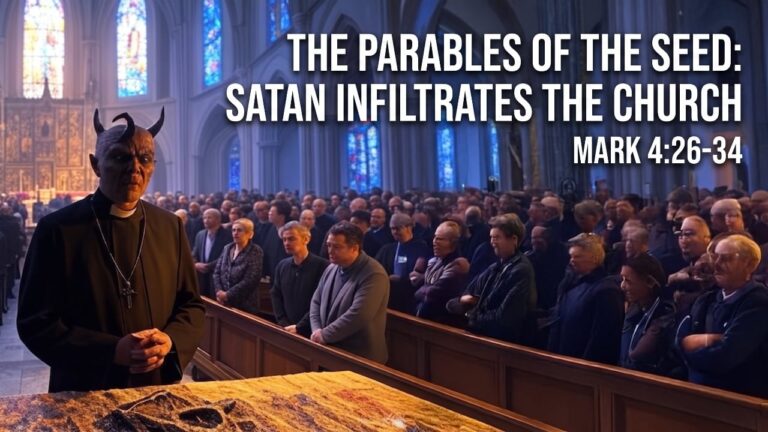
The public ministry of Jesus Christ underwent a radical, permanent structural transformation in the fourth chapter of Mark’s Gospel. Prior to this pivotal moment, the crowds received direct, clear instruction. Yet, a sudden change occurred: Jesus began addressing the public exclusively in parables. To understand this shift, we must look at the historical and spiritual climate surrounding the house of Israel at that moment.
In Mark 3, the religious leadership reached a final determination. Confronted with undeniable, history-altering miracles, they chose to reject the Messiah, King of Israel, attributing His divine works instead to Beelzebub. This national rejection resulted in a swift dispensational response. Christ withdrew the direct offer of the Davidic political kingdom from that generation, placing it on hold until a future generation welcomes Him in accordance with Psalm 118.
In its place, Jesus introduced a new spiritual program: the Mystery Kingdom, which manifests historically as the visible Church. This concept was a divine secret hidden from eternity past and unrevealed by the Old Testament prophets. In this new era, Jews and Gentiles are brought into equal fellowship in one body apart from the Mosaic Law, standing uniquely under the Law of the Messiah.
The Parable of the Sower acts as the structural foundation for this entire dispensational framework. Christ explicitly warns that if an individual cannot comprehend this basic message, they will fail to grasp any subsequent truths regarding the Kingdom. The four soils describe the underlying condition of the human heart when exposed to the Word of God:
The Wayside: Compacted ground where the seed cannot penetrate. The birds—which Jesus explicitly defines as Satan—instantly strip the text away before it can generate a response.
The Rocky Ground: A superficial, emotional response. These individuals receive the gospel with instant excitement, but lacking true root depth, they fall away the moment trial or social pressure arises.
The Thorny Ground: A direct biblical refutation of the modern Prosperity Gospel. These individuals are choked out by the worries of this age, the deceitfulness of wealth, and a consumerist mindset, remaining completely barren of true spiritual fruit.
The Good Ground: The chosen and elect ones of God. They hear the word, accept it fully, and display the unmistakable proof of saving faith: observable fruit production and a lifestyle of obedience.
The passage closes with a call to stewardship through the analogy of the elevated lampstand. Our spiritual growth is governed by the law of reciprocity: those who actively consume and apply the Word of God receive progressively greater insight, while those who treat it with passive neglect will find even their nominal understanding stripped away.
Deep biblical study with insights from the original Greek and Hebrew texts.
Exploring the richness of Scripture through detailed study of the original biblical languages, grammar, historical background, and literary context to uncover the depth and precision of God’s revelation.
Verse-by-verse teaching rooted in the authority of Scripture.
Carefully walking through each passage in its biblical context, examining the meaning of the text line by line, with a commitment to faithful interpretation and the full authority of God’s Word.
Clear, serious exposition focused on truth, context, and sound doctrine.
Presenting Scripture with clarity and careful analysis, emphasizing accurate interpretation, theological depth, and the importance of understanding God’s Word within its proper historical and biblical context.
Christ-centered teaching that equips believers to understand and live God’s Word.
Focusing on the person and work of Jesus Christ while helping believers grow in spiritual maturity, biblical understanding, discernment, and faithful obedience to the truths of Scripture.
Exploring Scripture carefully, faithfully, and without compromise.
Approaching the Bible with reverence, precision, and integrity—seeking to handle the text honestly, remain faithful to its intended meaning, and uphold the truth of God’s Word without distortion or cultural pressure.
Stay Connected to New Studies
Stay connected with the latest Bible studies, verse-by-verse teachings, article updates, and new video content. Join the newsletter to receive thoughtful biblical teaching, Scripture insights, and ministry updates directly in your inbox.
Have more questions?
If you would like more information about the ministry, need assistance with the website or resources, or simply want to get in touch, feel free to send a message.

Jesus is the Son of God! The Sea and the Demoniac (Mark 4:35-5:20)