Download today's Lesson Outline, or create your FREE account to instantly unlock the complete Premium Study Package✓ Complete verse-by-verse commentary✓ Teacher's and student guides✓ Printable lesson outline✓ Quiz and answer key✓ Additional study resources when available.
The opening verses of Mark 11 mark a monumental turning point in the earthly ministry of Jesus Christ. Having completed His journey from Galilee and ascended through the Judean wilderness, Jesus makes His formal public appearance in the capital city of Jerusalem. Often labeled as “The Triumphal Entry,” a careful exposition of Mark 11:1–14 reveals a narrative that stands in absolute opposition to worldly models of political conquest and imperial triumph. Instead, it showcases the formal presentation of a humble, sacrificial Messianic King who executes executive judicial inspection over His covenant people and issues a definitive condemnation of deceptive, empty religiosity.
Sovereign Foresight and the Authority of the Kyrios
As Jesus reaches Bethphage and Bethany on the eastern slopes of the Mount of Olives, He exhibits stunning, meticulous oversight that transcends normal human planning. Commissioning two unnamed disciples, He predicts with absolute precision the location, tethering, and exact condition of a specific animal: a young colt upon which no human being has ever sat. In biblical law, an animal reserved for sacred or royal usage had to be pristine and uncompromised by mundane agricultural labor (Numbers 19:2; Deuteronomy 21:3).
When questioned by local bystanders, the disciples respond with the authoritative phrase mandated by Jesus: “The Lord has need of it.” The employment of the Greek title Kyrios (Lord) here represents an exercise of divine right and absolute cosmic ownership over material creation. This authority is immediately validated by the supernatural submission of the unbroken colt, which perfectly yields to the physical presence of its incarnate Creator without resistance.
The Humility of Zechariah 9:9 vs. Political Blindness
By entering Jerusalem mounted upon a young donkey, Jesus deliberately fulfills the ancient messianic oracle of Zechariah 9:9. In the ancient Near East, a monarch rode a horse to signal military conquest, warfare, and imperial subjugation. Conversely, riding a donkey or a colt signaled a mission of peace, diplomacy, and administrative covenant. Jesus presents Himself to Israel as the Prince of Peace, offering spiritual reconciliation with God through His impending substitutionary death on the cross.
However, the enthusiastic crowd responds with profound, nationalistic confusion. They carpet the pathway with their garments and wave fresh leafy branches, crying out: “Hosanna! Blessed is He who comes in the name of the Lord!” (Mark 11:9). While these citations from Psalm 118 are messianically accurate, the crowd’s liturgical behavior reveals a deep spiritual blindness. The waving of branches was a mandatory feature of the autumn Feast of Tabernacles (Sukkot), which anticipated final kingdom glory and the physical destruction of Israel’s Gentile oppressors. The crowd treats the spring season of Passover—the solemn festival requiring a sacrificial lamb to avert divine wrath—as if it were the Feast of Tabernacles. They demand immediate political liberation from Rome while remaining completely blind to their internal captivity to sin.
The Enacted Parable of Judgment
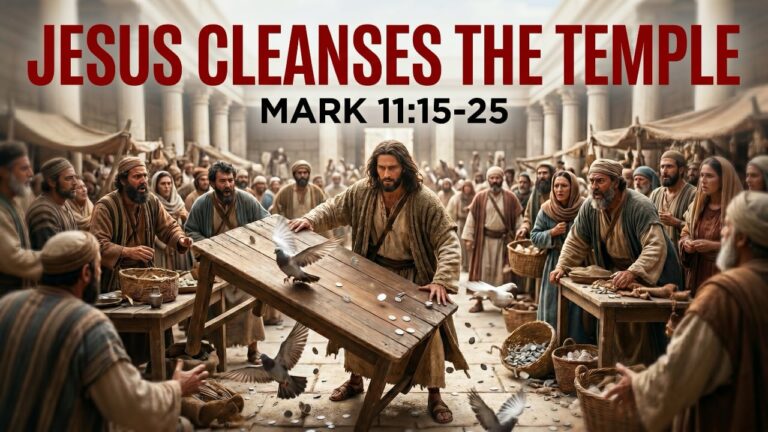
The true climax of the narrative occurs through a striking structural contrast. Upon entering Jerusalem, Jesus goes directly to the Temple, performs a silent, exhaustive inspection of everything occurring within its courts, and withdraws to Bethany due to the lateness of the hour. The following morning, on His return to the city, He encounters a fig tree in full leaf but completely devoid of fruit.
In the agricultural cycle of Israel, an abundance of early spring leaves on a fig tree biologically guarantees the presence of early edible buds (taish). By finding nothing but leaves, Jesus exposes a deceptive biological fraud. This tree perfectly symbolized the generation of Israel and its institutionalized Temple cultus: it was structurally in “full leaf” with magnificent architecture, white-robed priests, and ongoing sacrifices, yet it was entirely bankrupt of genuine spiritual fruit. In His capacity as Messianic Judge, Jesus pronounces a permanent sentence of condemnation: “May no one ever eat fruit from you again” (Mark 11:14). This enacted parable found its devastating historical fulfillment in 70 AD when the Roman legions burned the Temple to the ground and scattered the unrepentant nation, cementing an eternal truth: the true King demands authentic internal righteousness over deceptive, empty religious performance.
Deep biblical study with insights from the original Greek and Hebrew texts.
Exploring the richness of Scripture through detailed study of the original biblical languages, grammar, historical background, and literary context to uncover the depth and precision of God’s revelation.
Verse-by-verse teaching rooted in the authority of Scripture.
Carefully walking through each passage in its biblical context, examining the meaning of the text line by line, with a commitment to faithful interpretation and the full authority of God’s Word.
Clear, serious exposition focused on truth, context, and sound doctrine.
Presenting Scripture with clarity and careful analysis, emphasizing accurate interpretation, theological depth, and the importance of understanding God’s Word within its proper historical and biblical context.
Christ-centered teaching that equips believers to understand and live God’s Word.
Focusing on the person and work of Jesus Christ while helping believers grow in spiritual maturity, biblical understanding, discernment, and faithful obedience to the truths of Scripture.
Exploring Scripture carefully, faithfully, and without compromise.
Approaching the Bible with reverence, precision, and integrity—seeking to handle the text honestly, remain faithful to its intended meaning, and uphold the truth of God’s Word without distortion or cultural pressure.
Stay Connected to New Studies
Stay connected with the latest Bible studies, verse-by-verse teachings, article updates, and new video content. Join the newsletter to receive thoughtful biblical teaching, Scripture insights, and ministry updates directly in your inbox.
Have more questions?
If you would like more information about the ministry, need assistance with the website or resources, or simply want to get in touch, feel free to send a message.

Parable of the Vineyard (Mark 11:27-12:12)