Keep this lesson and your reflections together in My Study. Save it now, then return whenever you’re ready.
Download Today's Lesson
Download today's Lesson Outline, or create your FREE account to instantly unlock the complete Premium Study Package✓ Complete verse-by-verse commentary✓ Teacher's and student guides✓ Printable lesson outline✓ Quiz and answer key✓ Additional study resources when available.
A Foreshadowing of Israel’s Reception: An Exposition of Luke 4:14–30
In the structural layout of Luke’s Gospel, Luke 4:14–30 functions as far more than a routine introduction to the public itinerary of Jesus Christ. It operates as a precise theological preview and programmatic blueprint for the entire trajectory of His messianic ministry. Luke deliberately designs the narrative to demonstrate a sudden, definitive movement from widespread popularity to sharp local rejection, from superficial admiration to violent hostility, and from covenantal opportunity to nationalistic refusal. By reading from the prophetic scroll in His hometown synagogue of Nazareth, Christ formally inaugurates the New Covenant era of spiritual Jubilee. When faced with immediate skepticism rooted in human familiarity, He exposes Israel’s historical pattern of unbelief by citing the ancient Gentile missions of Elijah and Elisha. This provokes a nationalistic fury that prefigures His ultimate path to the cross while establishing the non-negotiable extension of God’s redemptive grace to all nations.
The Illusion of Regional Praise (Luke 4:14–15)
The narrative opens with Jesus returning from the wilderness temptations to the northern district of Galilee. Luke emphasizes that this entry is executed “in the power of the Spirit,” confirming that His public messianic ministry is fully energized, supported, and directed by the Holy Spirit. Initial reports regarding His teaching disseminate with immense speed throughout all the surrounding territory, and He systematically instructs the crowds within their local communal synagogues.
Luke notes that Christ was actively “being praised by all”. This opening reception serves a critical theological function: it establishes a intentional contrast. The widespread, external approval achieved in the wider district stands as a sharp foil to the intense, murderous hostility localized within His own domestic village. Luke is teaching the reader that external acclaim and superficial admiration do not equate to genuine, saving belief. The popular crowds admire the rhetorical brilliance and miraculous potential of Jesus, yet they remain entirely detached from the internal, spiritual demands of His message.
The Nazareth Manifesto and Spiritual Jubilee (Luke 4:16–19)
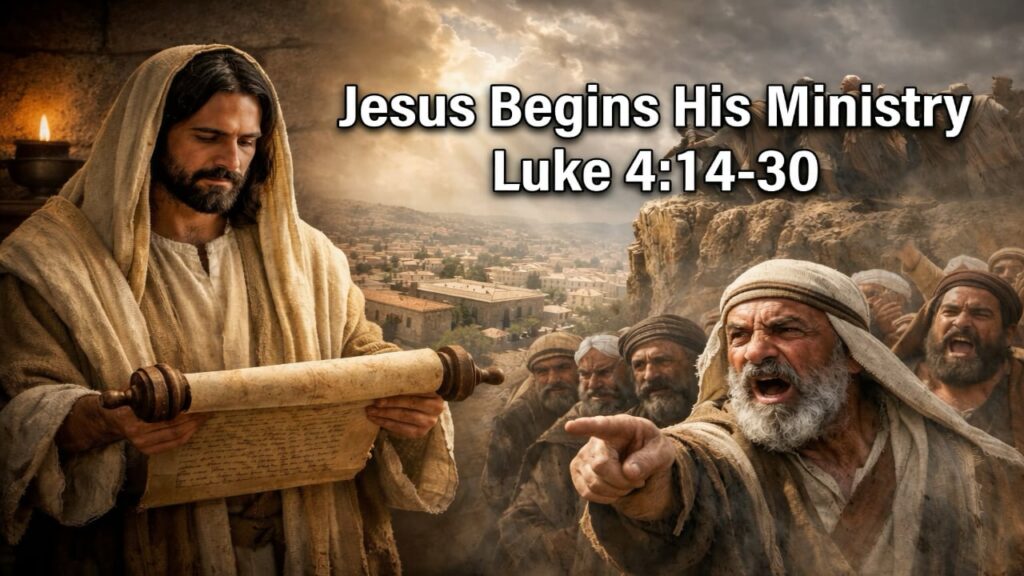
Entering Nazareth, the specific village where He had been raised, Jesus enters the local synagogue on the Sabbath day “as was His custom”. This detail reinforces that the rejection to follow is not born out of foreign unfamiliarity, but precisely because of intimate, domestic exposure. Standing up to read, He is handed the scroll of the prophet Isaiah. The text indicates that He deliberately unrolled the parchment, purposefully tracking down and selecting the exact passage of Isaiah 61:1–2. This was an intentional selection of a supreme Messianic text.
The content of the reading outlines the comprehensive mission of the Messiah: heralding good news to the poor, proclaiming release to captives, recovery of sight to the blind, and setting free those who are downtrodden. While these categories carry profound implications for lived human suffering, their foundational core is intensely spiritual, addressing the deeper human realities of poverty of spirit, complete legal bondage to sin, and absolute blindness to divine truth.
The reading culminates in the historic phrase: “To proclaim the favorable year of the Lord”. This statement links directly to the Old Testament economy of the Year of Jubilee, codified in Leviticus 25:9–10. Historically, the Jubilee was announced on the Day of Atonement by the blasting of a ram’s horn (yobel). It marked a monumental season of complete economic release, total debt forgiveness, and the mandatory restoration of ancestral inheritances.
Theologically, Jesus identifies Himself as the reality to which the type of Jubilee pointed. His coming—and ultimately His cross-centered death—brings the ultimate spiritual release: the complete erasure of moral debt before a holy God, true liberation from demonic and sinful bondage, and absolute restoration to the divine inheritance lost in Adam. Just as Jubilee follows the completion of a long cycle, Christ brings the absolute completion of God’s redemptive plan.
The Posture of Fulfillment and Skeptical Backlash (Luke 4:20–22)
Upon finishing the reading, Jesus rolls up the scroll, hands it back to the attendant, and sits down. In first-century Judaism, sitting was the formal, authoritative posture assumed by a rabbinic teacher about to deliver an official interpretation. The text records that the eyes of all in the synagogue were fixed intensely upon Him in a state of suspended expectation. He then breaks the silence with an exclusive statement of monumental force:
“Today this Scripture has been fulfilled in your hearing.”
The Greek verb translated “has been fulfilled” is peplerotai (πεπλήρωται), which sits in the perfect tense. This denotes a definitively completed historical action with ongoing, permanent results. The messianic fulfillment is not merely commencing; it is fully inaugurated, present, and embodied in His person. This statement is strictly exclusive, leaving absolutely no room for another messianic figure. By stating it was fulfilled “in your hearing,” Christ transforms the passive listeners into legal witnesses, forcing them into an immediate crisis of decision that leaves no neutral position.
The immediate response of the congregation in verse 22 is frequently misunderstood. The translation “speaking well of Him” is misleading, as the Greek verb emartyroun (ἐμαρτύρουν) signifies that they were bearing witness against Him with immediate incredulity, shock, and rising indignation. Their corporate amazement was not worshipful admiration, but deep skepticism and shock. This is instantly verified by their derisive query: “Is this not Joseph’s son?” They attempt to utilize their domestic familiarity with His human background to systematically undermine and dismiss His explicit claim to divine messianic identity.
Proverbial Rejection and Gentile Extension (Luke 4:23–27)
Perceiving their internal thoughts, Jesus exposes their true spiritual condition by anticipating their consumer demands for empirical proof: “You will say to Me, ‘Physician, heal yourself… do here what we heard was done in Capernaum.'” The multitudes did not desire divine truth; they demanded immediate, localized signs as a prerequisite for belief. Jesus counters their unbelief by stating a proverbial reality: “No prophet is accepted in his hometown.” What is intimately known is routinely undervalued by the unregenerate heart because familiarity breeds contempt.
To justify His refusal to perform signs for their entertainment, Jesus cites two devastating historical precedents from the ministries of Elijah and Elisha, during eras when Israel was in a state of systemic unbelief. He notes that during a severe national drought in the days of Elijah, though many desperate widows existed within the boundaries of covenant Israel, the prophet was sent exclusively to a Gentile widow in the pagan region of Zarephath. Likewise, in the days of Elisha, though the land of Israel was heavily populated with Jewish lepers, none were cleansed except Naaman the Syrian—a literal commander of an enemy Gentile army.
The theological thrust of these examples was precise and piercing. Jesus is demonstrating that when those who hold the primary covenant privileges reject the messenger through unbelief, the blessings of God are never nullified—they are redirected outward. This is not replacement theology; Israel does not lose its identity as God’s historical people. Rather, the specific saving blessings brought near by the Messiah are forfeited by the self-righteous elite and extended as an explicit expansion of grace to the Gentile nations.
Nationalistic Outrage and the Sovereign Pass-Through (Luke 4:28–30)
The moment Jesus implies that Gentiles could receive divine favor over unbelieving Jews, the synagogue assembly erupts into a violent, violent fury. Their deep pride, nationalistic prejudice, and sense of absolute entitlement are completely exposed. They rise up in a sustained mob action, driving Him out of the holy synagogue, out of the city boundaries, and toward the precipice of a steep cliff to throw Him down headlong to His death.
This violent escalation carries a heavy spiritual dimension. Positioned immediately after the wilderness temptation narrative, this encounter represents a direct, satanic attempt to execute Christ prematurely. In the desert, Satan attempted to derail the mission by offering soft alternatives to the cross; here, the strategy is to eliminate the Savior before He can ever reach the hill of Calvary. If Christ is murdered at a cliff in Nazareth, the blood atonement is aborted, and redemption is never accomplished.
Despite the overwhelming physical presence of the murderous mob holding Him at the edge of the cliff, the text notes an effortless manifestation of divine authority: “But passing through their midst, He went His way.” This cannot be rationalized as a natural escape or a tactical physical maneuver, as the mob had driven Him to the brink of execution. It was a sovereign, supernatural display of underived divine power and authority. Christ froze or parted the crowd by His sheer administrative will. His life was completely un-subject to human anger or premature timing; He could not be taken until He willingly laid His life down at the cross. His mission proceeded according to the Father’s timing, leaving the raging crowds entirely paralyzed as He continued His path of redemptive purpose.
Core Reflections
The Danger of Superficial Praise: The same Galilean crowds that enthusiastically praised Jesus’ generic ministry instantly turned into a murderous mob when His message directly confronted their personal pride and nationalistic entitlement. True faith submits to the internal demands of Lordship, rather than merely admiring the exterior benefits of the gospel.
The Reality of Spiritual Jubilee: Jesus is the absolute embodiment and completion of the Old Testament Year of Jubilee. True release from the crushing legal debt of sin, absolute liberation from spiritual blindness, and the recovery of our eternal inheritance are found exclusively in His finished, cross-centered work.
The Cognitive Block of Familiarity: The citizens of Nazareth allowed their domestic familiarity with Jesus’ human background to totally blind them to His essential divine identity. Believers must consistently guard against allowing a casual, long-term familiarity with church culture or biblical facts to erode a deep, holy trembling before the living Word of God.
The Sovereignty of the Mission: Christ’s effortless walk through the center of a murderous mob demonstrates that the progression of redemption is entirely under divine authority. He was never a tragic victim of human history or political schemes; He was the sovereign Master of His timeline, completely protected until the appointed hour when He would lay His life down voluntarily at Calvary.
Deep biblical study with insights from the original Greek and Hebrew texts.
Exploring the richness of Scripture through detailed study of the original biblical languages, grammar, historical background, and literary context to uncover the depth and precision of God’s revelation.
Verse-by-verse teaching rooted in the authority of Scripture.
Carefully walking through each passage in its biblical context, examining the meaning of the text line by line, with a commitment to faithful interpretation and the full authority of God’s Word.
Clear, serious exposition focused on truth, context, and sound doctrine.
Presenting Scripture with clarity and careful analysis, emphasizing accurate interpretation, theological depth, and the importance of understanding God’s Word within its proper historical and biblical context.
Christ-centered teaching that equips believers to understand and live God’s Word.
Focusing on the person and work of Jesus Christ while helping believers grow in spiritual maturity, biblical understanding, discernment, and faithful obedience to the truths of Scripture.
Exploring Scripture carefully, faithfully, and without compromise.
Approaching the Bible with reverence, precision, and integrity—seeking to handle the text honestly, remain faithful to its intended meaning, and uphold the truth of God’s Word without distortion or cultural pressure.
Stay Connected to New Studies
Stay connected with the latest Bible studies, verse-by-verse teachings, article updates, and new video content. Join the newsletter to receive thoughtful biblical teaching, Scripture insights, and ministry updates directly in your inbox.
Have more questions?
If you would like more information about the ministry, need assistance with the website or resources, or simply want to get in touch, feel free to send a message.