Download today's Lesson Outline, or create your FREE account to instantly unlock the complete Premium Study Package✓ Complete verse-by-verse commentary✓ Teacher's and student guides✓ Printable lesson outline✓ Quiz and answer key✓ Additional study resources when available.
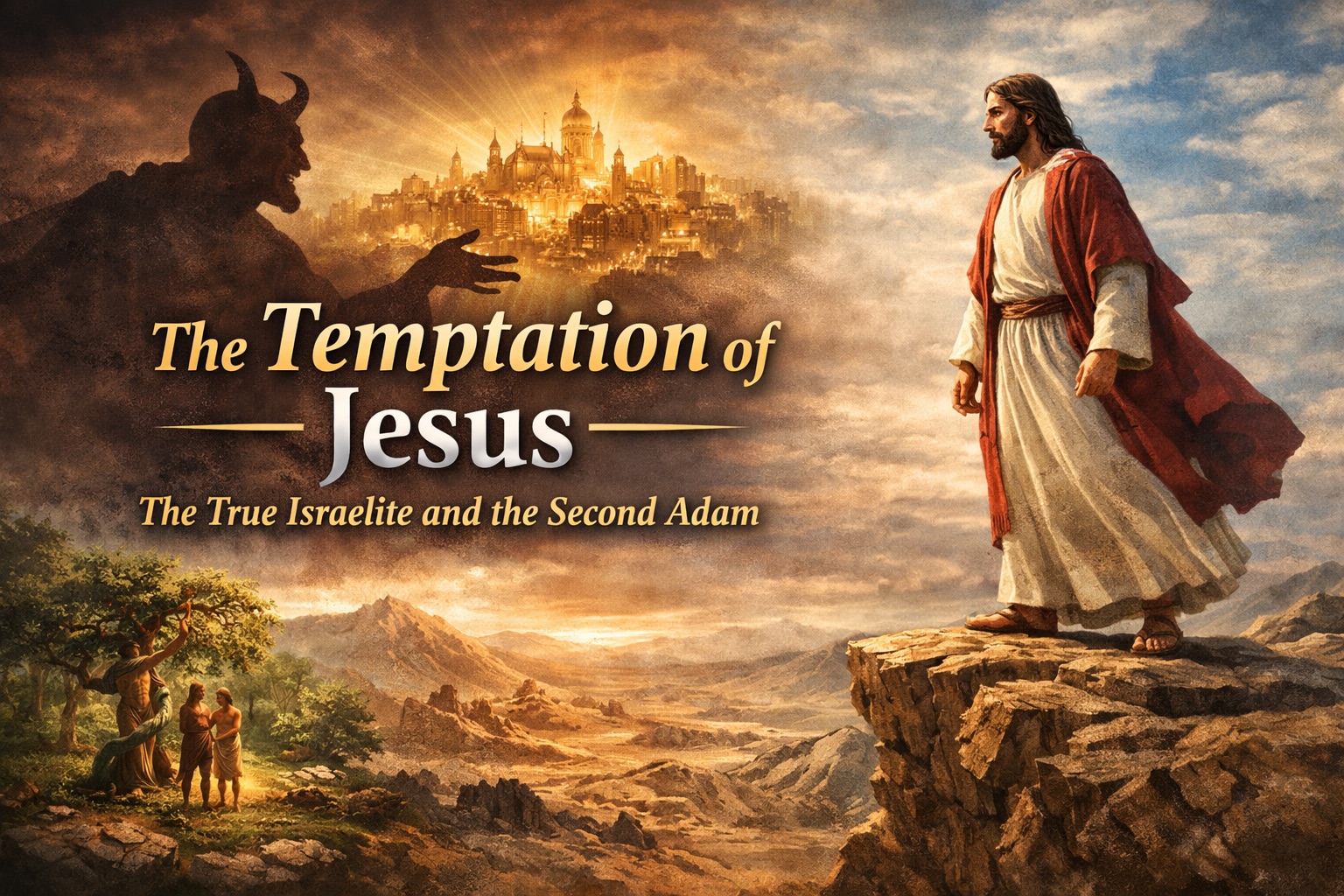
The historical account of Jesus’ temptation in the wilderness functions as a critical theological bridge within Luke’s Gospel. Immediately following His baptism, where He is publicly affirmed by the Father as the beloved Son of God, that Sonship is subjected to a rigorous covenantal test. Driven and continuously guided by the Holy Spirit, Jesus undergoes forty days of intense deprivation. This event is not an accidental detour; it is an intentional, divinely orchestrated reenactment of history. Jesus stands in the wilderness to systematically relive and reverse the catastrophic corporate failures of ancient Israel across forty years, and the original failure of Adam within the garden.
The Orchestration of the Wilderness Domain (Luke 4:1–2)
Luke opens the narrative by noting that Jesus, filled with the Holy Spirit, returned from the Jordan and was continuously led by the Spirit in the wilderness. The Greek text relies on the imperfect passive verb ēgeto, which signifies an ongoing, progressive guidance over the entire duration of the forty days. Jesus is not wandering aimlessly; He is being dynamically steered by the Holy Spirit through a harsh terrain of trial.
This tracks perfectly with the historical movement of corporate Israel, which did not wander chaotically through the desert but was systematically guided by the pillar of cloud and fire. The forty days explicitly parallel Israel’s forty years of wilderness testing. God intentionally permitted hunger to test the internal priorities of His people, establishing a platform where true obedience must transcend physical material survival. Where corporate Israel grew impatient, grumbled, and failed, Jesus stands as the faithful Servant who executes the Father’s will perfectly.
Independent Provision Refused (Luke 4:3–4)
Satan initiates his assault by targeting Christ’s severe physical hunger, utilizing a precise first-class conditional clause: “Since You are the Son of God.”The enemy is not demonstrating intellectual doubt concerning Christ’s essential identity; rather, he is challenging the functional parameters of His submission. He urges Jesus to use His divine, authoritative status independently of the Father’s specific timing and providential path.
Satan commands immediate action using two rapid aorist imperatives: “Speak now”and “Become.”These terms demand a decisive display of independent creative power to turn stones into bread. Had Jesus complied, He would have broken solidarity with suffering humanity and refused the path of physical dependency ordained by the Father. Christ completely shatters the assault by deploying Deuteronomy 8:3:
“It is written, ‘Man shall not live by bread alone.'”
By relying on the generic term ho anthropos(“the man”), Jesus transitions from Israel’s corporate history to a universal individual application: human life is fundamentally sustained and validated not by material consumption, but by absolute alignment with the proceeding word of God.
The Shortcut to Dominion Rejected (Luke 4:5–8)
The second assault escalates into the dimension of visual and political glory. Satan supernaturally transports Jesus, presenting an instantaneous display of all the kingdoms of the inhabited earth. Luke uses the unique term stigmē, which signifies a singular, indivisible moment of time, proving this was a real, miraculous external presentation rather than a subjective internal vision.
Satan asserts a threefold claim of authority: the kingdoms are his, they have been handed over to him, and he grants them to whomever he wishes. This claim stems directly from the catastrophic collapse in Genesis 3, where humanity willfully forfeited its creation dominion, surrendering its moral stewardship into the hands of the deceiver.
The core of the satanic offer is a counterfeit messianic shortcut: global rule and immediate political dominion without the absolute necessity of the cross. Satan promises to hand over the world instantly if Jesus will execute a single, decisive, and historically irreversible act of worshipful allegiance before him. Had Jesus bowed, it would have signaled cosmic rebellion at the highest level—leaving humanity eternally unredeemed because all true restoration pivots exclusively on the cross. While the future Antichrist will formally accept this dark compromise, Jesus completely shatters the offer by declaring that Yahweh alone must be worshiped and served.
Presumptuous Protection Defied (Luke 4:9–12)
For the third assault, Jesus is physically transported to Jerusalem and positioned atop the highest pinnacle of the temple complex. This scenario moves the test from a secluded desert to a highly public, visible setting. Satan shifts his tactics by attempting to weaponize Scripture itself, quoting directly from Psalm 91:11–12: “He will command His angels concerning You to guard You.”
The subtle danger of this temptation is the distortion of authentic faith into presumptuous pride. Satan is urging Jesus to deliberately force a divine intervention, creating a public spectacle that would compel the Father to suspend physical laws to save Him. This mirrors Israel’s ancient sin at Massah, where they updated their posture from trusting God to testing Him, demanding empirical proofs of His presence. Jesus responds by deploying Deuteronomy 6:16:
“You shall not put the Lord your God to the test.”
True faith rests securely in God’s promises without demanding sensational, self-directed proofs.
The Covenantal Victory of the Faithful Son (Luke 4:13)
Luke concludes the account by noting that when the devil had finished every temptation, he departed from Him until an “opportune time.”The completion of these specific encounters indicates that Jesus had faced and thoroughly defeated all standard categories of human vulnerability—spanning the lust of the flesh, the lust of the eyes, and the pride of life.
The contrast reveals Christ’s ultimate identity as the Second Adam and the True Israelite. Where the first Adam failed in a pristine garden surrounded by abundance, Jesus succeeded in a brutal desert surrounded by deprivation. Where corporate Israel failed across forty years of unfaithfulness, Jesus conquered across forty days of absolute submission. The temporary departure of the enemy until an “opportune time” signals that this victory, though complete, prefigured the larger conflict of Calvary. Jesus did not merely resist temptation; He secured an absolute victory, standing as the Faithful Son who obeys where all others failed.
Core Reflections
The Portal of Appointed Trial: God intentionally permits seasons of wilderness testing to prove and refine covenant faithfulness. Being led by the Spirit does not guarantee an immediate path of physical comfort; rather, it locks us into a domain where our reliance on God overrides material circumstances.
The Deception of the Shortcut:Satan continuously offers shortcuts to spiritual maturity, influence, or validation that bypass the necessity of cross-bearing and daily self-denial. True kingdom restoration can never rely on an independent compromise; it demands absolute alignment with the path ordained by the Father.
The Weaponization of Data: The enemy possesses a chilling capacity to memorize and manipulate scriptural text to foster presumptuous pride and independent action. Academic or intellectual familiarity with biblical facts is completely insufficient; true victory over deception requires a heart submissively aligned with the authority of the living Word.
Deep biblical study with insights from the original Greek and Hebrew texts.
Exploring the richness of Scripture through detailed study of the original biblical languages, grammar, historical background, and literary context to uncover the depth and precision of God’s revelation.
Verse-by-verse teaching rooted in the authority of Scripture.
Carefully walking through each passage in its biblical context, examining the meaning of the text line by line, with a commitment to faithful interpretation and the full authority of God’s Word.
Clear, serious exposition focused on truth, context, and sound doctrine.
Presenting Scripture with clarity and careful analysis, emphasizing accurate interpretation, theological depth, and the importance of understanding God’s Word within its proper historical and biblical context.
Christ-centered teaching that equips believers to understand and live God’s Word.
Focusing on the person and work of Jesus Christ while helping believers grow in spiritual maturity, biblical understanding, discernment, and faithful obedience to the truths of Scripture.
Exploring Scripture carefully, faithfully, and without compromise.
Approaching the Bible with reverence, precision, and integrity—seeking to handle the text honestly, remain faithful to its intended meaning, and uphold the truth of God’s Word without distortion or cultural pressure.
Stay Connected to New Studies
Stay connected with the latest Bible studies, verse-by-verse teachings, article updates, and new video content. Join the newsletter to receive thoughtful biblical teaching, Scripture insights, and ministry updates directly in your inbox.
Have more questions?
If you would like more information about the ministry, need assistance with the website or resources, or simply want to get in touch, feel free to send a message.