Download today's Lesson Outline, or create your FREE account to instantly unlock the complete Premium Study Package✓ Complete verse-by-verse commentary✓ Teacher's and student guides✓ Printable lesson outline✓ Quiz and answer key✓ Additional study resources when available.
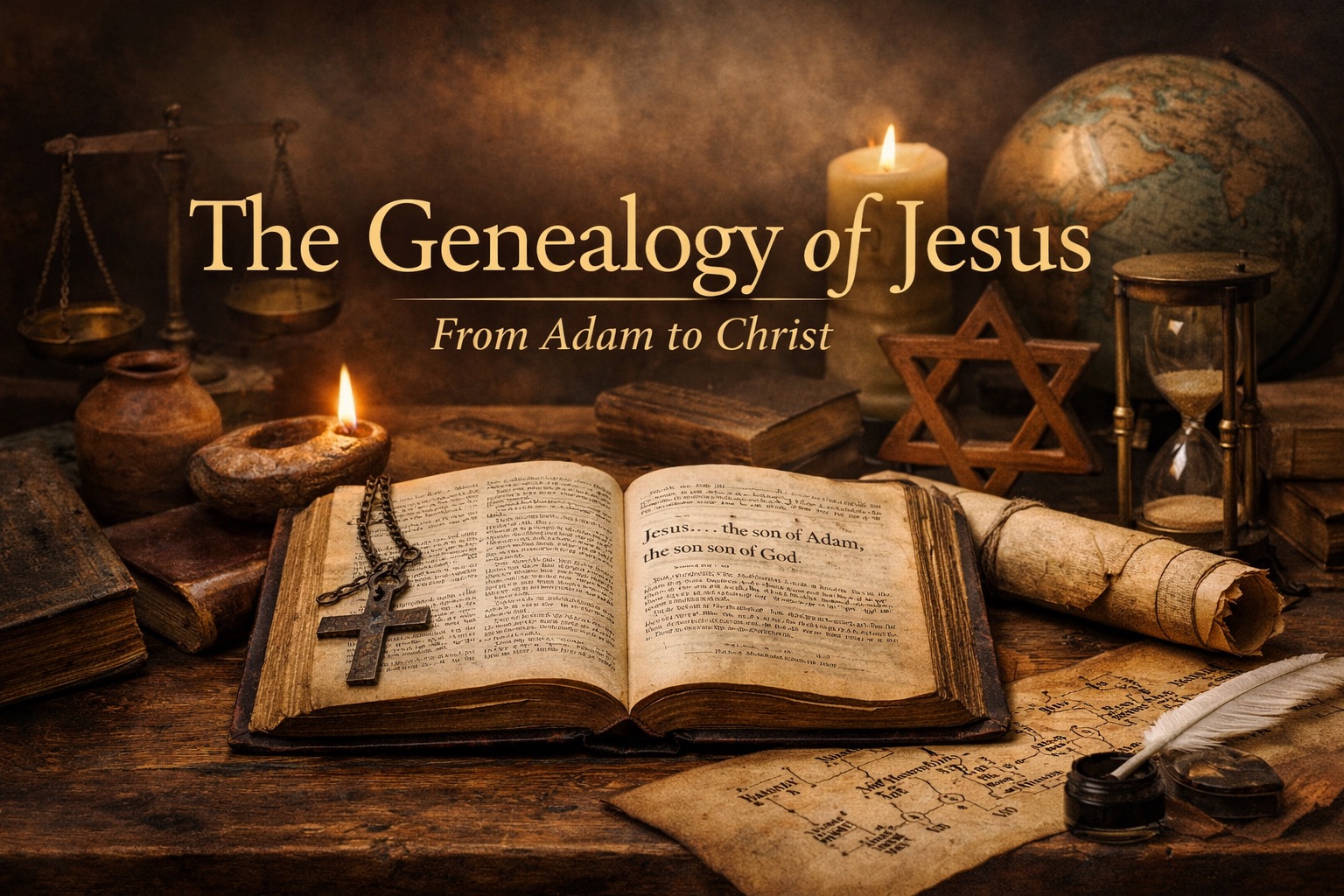
In the structural progression of Luke’s Gospel, the genealogical record of Jesus Christ is positioned with precise theological intentionality. It stands directly between the public presentation of His divine Sonship at His baptism and the active testing of that identity in the wilderness. This strategic placement resolves the foundational question of Christ’s true humanity and cosmic qualifications. Moving backward from Jesus all the way to Adam, Luke demonstrates that Christ is not merely a regional monarch, but the representative Savior for all of mankind.
The Priestly Baseline and the Virgin Birth (Luke 3:23)
Luke initiates the lineage by specifying that when Jesus began His public ministry, He was approximately thirty years of age. This chronological detail is rooted in the Mosaic economy, aligning precisely with the required legal threshold for entering active priestly service and handling tabernacle burdens. By waiting for this mature structural age, Jesus fulfills the legal patterns of Israel.
The text immediately follows with a critical parenthetical statement that carefully preserves the central doctrine of the virgin birth: “being, as was supposed, the son of Joseph”. The Greek verb translated “as was supposed” is enomizeto(ἐνομίζετο), an imperfect passive form denoting a continuous, mistaken public assumption. While the surrounding population naturally assumed a standard biological relationship with Joseph, Luke utilizes this specific phrasing to decouple legal association from biological descent, safeguarding Christ’s divine origin as the Son of God conceived by the Holy Spirit.
The Davidic Branch: Royal Title vs. Biological Line (Luke 3:24–31)
As the lineage moves backward into the monarchical era of Israel, it reveals an essential structural divergence from the genealogy recorded in Matthew 1. While Matthew tracks the royal, legal line descending from David through King Solomon, Luke traces a non-royal, private lineage descending from David through another son, Nathan. This intentional variation addresses a critical legal obstacle under the Old Covenant.
In Jeremiah 22:30, due to the severe apostasy of King Jehoiachin (Coniah), God pronounced a permanent bloodline curse upon his lineage, declaring that no physical descendant of his would ever prosper sitting upon the throne of David. This created a profound dilemma: the Messiah had to be a physical descendant of David, yet any physical heir traveling through the successive kingly line of Solomon was structurally disqualified from ruling.
The two Gospel accounts resolve this perfectly. Through Joseph’s line in Matthew, Jesus secures full dynastic, legal rights to the throne, as Joseph was a legal heir to the kingdom. However, because Joseph was not the biological father of Jesus, the physical curse of Coniah never touches Him. Through Mary’s line—tracked biologically by Luke through Nathan—Jesus inherits the actual physical seed and flesh of David completely free from the royal bloodline disqualification.
Moral Fractures and the Metric of the Curse (Luke 3:32–36)
Moving past David into the patriarchal era, the genealogy incorporates names like Zerubbabel and Shealtiel, who are intimately associated with post-exilic temple restoration history, as well as Perez from Genesis 38. The inclusion of Perez—born out of the broken narrative of Judah and Tamar—serves as a powerful reminder that the messianic lineage absorbs morally complex and fractured human histories. God preserves His redemptive line through situations marked by human failure, demonstrating that sovereign grace operates through the brokenness of history to accomplish salvation.
Furthermore, Luke’s record aligns perfectly with the historical lists of Genesis 11, tracing the names from Shem to Abraham with absolute precision. This structural tracking uncovers a sobering biological reality: the progressive decline of human lifespans following the Flood. Noah lives for 950 years, Shem drops to 600 years, and by the time of Abraham, the human lifespan declines to 175 years. This systematic reduction operates as a physical index of the progressive, destructive effects of sin and divine judgment working within human biology, confirming that the entrance of sin introduces physical decay into creation.
The Universal Origin and the Second Adam (Luke 3:37–38)
The climax of Luke’s entire genealogical strategy is unveiled in its final verse, where the line terminates completely in “Adam, the son of God”. This structural conclusion serves a major theological purpose that differentiates Luke from Matthew. Matthew terminates his lineage at Abraham, deliberately bounding his theology within an ethnic, Jewish focus to present Jesus as the Messiah of Israel. Luke completely bypasses this ethnic limitation, traveling past Abraham and Noah to the singular father of all humanity.
By tracing Jesus directly back to Adam, Luke establishes that Christ is not merely the Savior of a localized nation; He is universally relevant to all of mankind. Every human being, regardless of national origin, shares a biological root in Adam. Therefore, by entering into Adam’s line, Jesus qualifies as the representative Savior of humanity.
This provides the necessary foundation for the doctrine of Christ as the Second Adam. The first Adam was a direct creation of God who brought sin, judgment, and physical death into human history through his disobedience. Jesus enters this exact human line as the ultimate Son of God—the faithful corporate Representative who brings righteousness, justification, and eternal life, completely reversing the ancient curse and restoring what was lost in the Fall.
Core Reflections for Ministry
The Reality of Christ’s Humanity:Luke traces a real, historical lineage of ordinary and often obscure individuals to prove Christ’s absolute humanity. The Savior of the world possesses real human flesh and blood, rendering Him fully capable of sympathizing with our weaknesses.
Grace through Brokenness:The inclusion of morally fractured histories, such as Perez, demonstrates that God’s redemptive plan is immune to human moral failure. He weaves His grace through the complicated and fallen histories of mankind to show that salvation is a work of sovereign mercy, not human achievement.
The Sufficiency of the New Headship:By terminating the lineage in Adam rather than Abraham, the text exalts Christ as the universal Second Adam. We are all born under the headship of the first Adam, inheriting sin and death; true salvation is found exclusively by being relocated under the life-giving headship of Jesus Christ.
Deep biblical study with insights from the original Greek and Hebrew texts.
Exploring the richness of Scripture through detailed study of the original biblical languages, grammar, historical background, and literary context to uncover the depth and precision of God’s revelation.
Verse-by-verse teaching rooted in the authority of Scripture.
Carefully walking through each passage in its biblical context, examining the meaning of the text line by line, with a commitment to faithful interpretation and the full authority of God’s Word.
Clear, serious exposition focused on truth, context, and sound doctrine.
Presenting Scripture with clarity and careful analysis, emphasizing accurate interpretation, theological depth, and the importance of understanding God’s Word within its proper historical and biblical context.
Christ-centered teaching that equips believers to understand and live God’s Word.
Focusing on the person and work of Jesus Christ while helping believers grow in spiritual maturity, biblical understanding, discernment, and faithful obedience to the truths of Scripture.
Exploring Scripture carefully, faithfully, and without compromise.
Approaching the Bible with reverence, precision, and integrity—seeking to handle the text honestly, remain faithful to its intended meaning, and uphold the truth of God’s Word without distortion or cultural pressure.
Stay Connected to New Studies
Stay connected with the latest Bible studies, verse-by-verse teachings, article updates, and new video content. Join the newsletter to receive thoughtful biblical teaching, Scripture insights, and ministry updates directly in your inbox.
Have more questions?
If you would like more information about the ministry, need assistance with the website or resources, or simply want to get in touch, feel free to send a message.